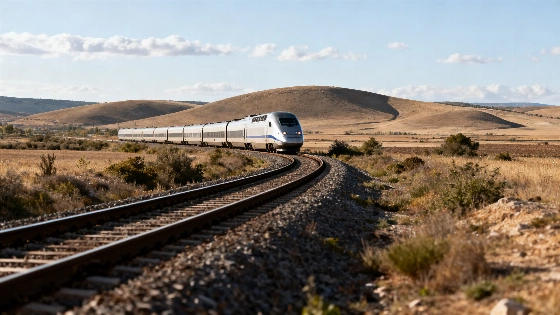
High-speed trains in Castile and León forced to slow down due to restrictions. Ten temporary speed restrictions are in effect on AVE lines in Castile and León, impacting the Madrid–Galicia and Valladolid–León routes. The reason is safety measures and ongoing infrastructure work.
In Castile and León, temporary speed restrictions have been introduced on ten sections of the AVE high-speed rail lines. According to the operator Adif, these measures primarily affect the Madrid–Galicia line via Zamora and Sanabria, as well as the Valladolid–León route via Palencia. At the same time, the line to Burgos remains without similar restrictions.
Speed restrictions on high-speed lines are a standard safety practice and are implemented during maintenance works. Currently, trains are forced to reduce their speed on certain sections to between 30–200 km/h, and on some stretches, even lower. This impacts the timetable and can increase travel time for passengers.
On the northern route, the first speed reduction zone is located near Segovia-Guiomar station. Here, trains pass a section of several hundred meters at a reduced speed. Further restrictions are found between Medina del Campo and the border with the Galician network via Zamora. In Zamora province itself, limits apply both near the city and in the areas of Tábara, Pedralba de la Pradería, and Requejo.
On the Valladolid–Palencia line, the most significant restrictions have been introduced on the approaches to Valladolid Campo Grande station, where trains are forced to considerably slow down. Several other restricted sections have been noted in the Villada area. In León province, restrictions apply to areas near Trobajo del Cerecedo and upon entering the city itself.
As Adif notes, such measures are regularly updated and are part of the standard management of the high-speed rail network. Their goal is to maintain safety and ensure timely infrastructure maintenance.
For reference: the AVE network in Spain is one of the largest in Europe, with a length exceeding 3,700 km. Temporary speed restrictions can be introduced due to scheduled works, weather conditions, or technical inspections. Such measures are usually not long-term but can affect schedule accuracy and travel comfort.