Tesla Ends Production of Model S and Model X: Focus Shifts to Robots and Autonomy. Tesla has officially ended production of the Model S and Model X, which had served as the brand’s flagships for over a decade. The decision is driven not only by declining demand, but also by the company’s new strategic direction towards artificial intelligence, robotics, and autonomous transportation.
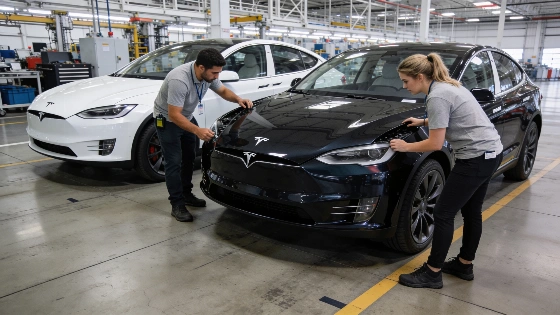
The last units of the Model S and Model X have left Tesla’s Fremont factory—marking the end of an era for the company. These models once made Tesla a prominent player in the global electric vehicle market, but now their story has come to an end. As Autobild notes, the decision is not only due to declining sales: the Model S and Model X have long ceded their place to the more affordable Model 3 and Model Y, which now generate the brand’s main revenue.
The Model S, launched in 2012, was the first electric car capable of competing with luxury sedans in terms of range and technology. The Model X, which debuted in 2015, stood out for its unique 'gull-wing' doors and became a symbol of Tesla’s engineering ambitions. However, over the years, both cars became niche products: their share of the company’s total sales dwindled, and consumer interest shifted towards more mainstream and affordable models.
Before leaving the market for good, Tesla released a limited Signature Edition series—only 350 cars, with 250 Model S and 100 Model X. These vehicles were available exclusively by invitation to loyal customers and featured unique color schemes and trim details. Essentially, these are collector's items unlikely to be seen on public roads.
The discontinuation of the Model S and Model X is part of a broader transformation at Tesla. Elon Musk has long emphasized that the company no longer wants to be associated solely with the automotive industry. The focus is now on artificial intelligence, robotics, and autonomous systems. The production capacity freed up in Fremont will be partially redirected to manufacture the humanoid robot Optimus, which Tesla envisions performing industrial, logistic, and household tasks.
At the same time, Tesla is actively investing in the development of fully autonomous transportation. The main focus is the Cybercab project: a robotaxi with no steering wheel or pedals, designed for urban fleet operations. Musk claims that the production volume of the Cybercab could surpass that of all current Tesla models combined, highlighting the company’s shift in priorities. However, despite these ambitious statements, the rollout of autonomous technologies has been slower than expected: launch dates continue to be pushed back, and the real capabilities of the autopilot systems are still limited.
Tesla’s shift towards new directions reflects a general trend in the automotive industry: manufacturers are searching for new sources of growth beyond the traditional market. Similar processes are underway among competitors—for example, Audi recently introduced a new generation of the Q7 with a focus on future technologies, which was covered in detail in the article about the latest flagship from the German brand.
For Tesla, discontinuing the Model S and Model X is not just a move away from the premium segment, but an attempt to take a leading position in new technological niches. How successful this strategy will be will become clear in the next decade: for now, the company is betting on robotics, autonomy, and artificial intelligence, leaving traditional electric cars behind.