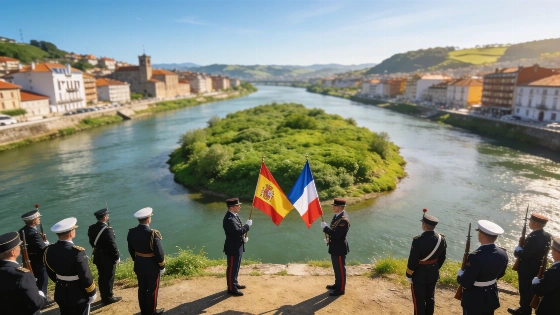
Pheasant Island, a 6,820-square-meter islet in the Bidasoa River, is jointly governed by Spain and France. Every six months, the two countries formally transfer jurisdiction, making it the world's smallest condominium and a rare example of peaceful border cooperation.
In the middle of the Bidasoa River, between the Spanish town of Irún and the French city of Hendaye, lies Pheasant Island—a patch of land just 6,820 square meters in size. Despite its modest footprint and lack of inhabitants, this island is the stage for one of Europe's most unusual border arrangements: every six months, sovereignty alternates between Spain and France.
From February 1 to July 31, Spanish authorities are responsible for the island. On August 1, the French take over, holding jurisdiction until the end of January. The handover is marked by a formal ceremony attended by civil and military officials from both countries. During this event, flags are exchanged and the transfer of authority is officially recorded, but the island remains legally shared by both nations throughout the year.
Historic Agreements
The roots of this arrangement go back centuries. In 1856, the Treaty of Bayonne established that Pheasant Island would be held pro indiviso—jointly and undivided—by Spain and France. A later agreement in 1901 set the current system of alternating six-month periods of administration. The rules also clarify which courts have jurisdiction in case of legal issues: Spanish and French citizens answer to their own national authorities, while citizens of other countries fall under the control of whichever nation is in charge at the time.
A Site of Peace
Pheasant Island's diplomatic significance is even older. On November 7, 1659, it hosted the signing of the Treaty of the Pyrenees, which ended 24 years of war between the Spanish and French crowns. Negotiations took place in a specially built pavilion at the island's center, with separate entrances for each delegation to avoid crossing into the other's territory. The treaty included major territorial concessions and arranged the marriage of Louis XIV of France to Maria Theresa of Austria, daughter of Philip IV of Spain—a union celebrated in San Juan de Luz the following year.
Today, the only structure on the island is a mid-19th-century monument commemorating the historic treaty, standing as a reminder of the island's role in shaping European history.
Governance and Daily Reality
Responsibility for the island alternates between the naval commanders of San Sebastián and Bayonne, who act as official representatives of their respective countries. The municipalities of Irún and Hendaye assist with maintenance and conservation, but there are no permanent residents, no homes, and no local government. The landscape is dominated by trees, wild vegetation, and the solitary monument—a symbol of cooperation rather than division.
Pheasant Island remains closed to the public, with access restricted to official visits and ceremonies. Its unique status as the world's smallest condominium and its peaceful, ritualized transfer of authority make it a rare example of enduring cross-border collaboration.
Additional context: Pheasant Island is not only a diplomatic curiosity but also a living reminder of how historical rivalries can give way to practical cooperation. While the island itself is uninhabited and largely inaccessible, its continued existence as a shared territory reflects the ability of neighboring countries to manage borders without conflict—a lesson that remains relevant in today's Europe.