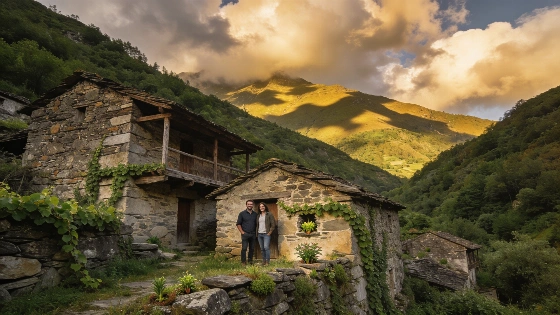
Ana Isabel and Máximo left city life behind to buy and restore a centuries-old abandoned village in Asturias. Their unusual purchase, made possible by a rare set of circumstances, has given new life to a place once lost to time.
When Ana Isabel first set foot in the overgrown ruins of a remote Asturian braña, she saw more than collapsed roofs and tangled brambles. She saw a chance to start over. Years later, that vision has become reality: together with her partner Máximo, Ana has transformed a forgotten cluster of stone houses into a living, breathing village once again.
Their journey began with a stroke of luck. Unlike most abandoned villages in Spain, where ownership is split among dozens of heirs, every property in this braña belonged to a single family. Ana, a former mining worker from Oviedo, learned about the opportunity from a friend just as she was looking for a new direction after a career change. The seller’s father had quietly bought up the homes as neighbors left for industrial jobs, making the sale unusually straightforward. “We didn’t have to fight with anyone,” Ana recalls. That simplicity made all the difference.
What they found was a place nearly swallowed by nature. Brambles reached halfway up the walls, and centuries of neglect had left the houses in ruins. But Ana saw potential where others saw only decay. The braña, dating back to the 14th century, once housed more than two dozen vaqueiros—cattle herders who lived there year-round, producing charcoal and tending livestock. Industrialization emptied the settlement as families moved to Avilés and Gijón in search of easier lives. Ana and Máximo chose the opposite path, returning to the mountains to rebuild what had been lost.
The first house they restored was “la bouza,” the oldest in the group, still boasting its original wood-fired oven. Their current home, the last to be rehabilitated, was chosen for its sweeping views and sunlit orientation. Máximo joined the project after meeting Ana following a car accident. “I came for love, and I stayed for everything else—the place won me over too,” he admits. Their initial plan was to create a retirement haven and rent out the other houses, but the project quickly became much more than that.
Today, Ana and Máximo live with electricity and fresh mountain water, a privilege in such a remote spot. The nearest shop is in San Martín, seven kilometers away, and the final stretch of road is only passable by four-wheel drive—especially in winter. They hope to rent out the restored homes year-round, but say the local council’s help is needed to repair the last 200 meters of access road. With no children to inherit the project, they plan to stay “until the end.”
Yet their new life is not without concerns. The couple worries about plans to install 224-meter wind turbines on the Sierra del Pomar, the very ridge that supplies water to the entire area. Protecting the natural environment is as important to them as preserving the village itself.
Ana offers a message to anyone dreaming of a rural escape: “If you let fear stop you, you’ll never do anything.” Máximo’s advice for newcomers is simple but essential—talk to the neighbors and adapt to local ways. Their story echoes a growing movement of people seeking meaning and self-sufficiency in Spain’s forgotten corners. In fact, Ana and Máximo’s experience shares a spirit with others who have chosen a similar path, such as María García, who left her city job to buy a derelict house in the Asturian forest—a journey detailed here.
As rural Spain faces depopulation and the challenges of modern life, stories like Ana and Máximo’s highlight both the obstacles and the rewards of bringing lost places back to life. Their project stands as a reminder that, with determination and a bit of luck, even the most abandoned corners can find a future again.