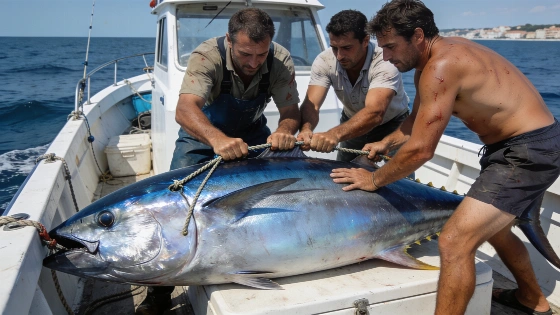
Ludovic, Florian, and Jonathan Delmée spent nearly two hours fighting a 230-kilo bluefin tuna just 5.5 kilometers off Sète. The massive fish, measuring 2.6 meters, had to be towed to port and lifted with special equipment. Their catch highlights both the thrill and the strict regulations of Mediterranean tuna fishing.
At 1:00 p.m. on August 2, 2026, the fishing line of Ludovic, Florian, and Jonathan Delmée suddenly jerked with a force none of them had felt before. Just 5.5 kilometers off the French coast near Sète, the three brothers—professionals in fishing and maritime excursions—realized instantly that this was no ordinary catch. What followed was a nearly two-hour struggle, as they took turns battling a bluefin tuna that would ultimately tip the scales at 230 kilos and stretch 2.6 meters in length.
The fight demanded every ounce of their coordination and endurance. The tuna made repeated, powerful runs, forcing the brothers to rotate at the rod to maintain pressure and avoid exhaustion. The entire episode was captured on video, later spreading across social media, showing the trio’s raw celebration—shouts, embraces, and even a cap tossed onto the deck—when the fish finally surfaced beside their boat.
The Challenge of Landing a Giant
Getting the tuna to the surface was only half the battle. Its sheer size made it impossible to haul aboard with manpower alone. Instead, the brothers secured the fish by its head and tail, then slowly towed it alongside their vessel back to Sète. Once in port, a lifting gantry was required to hoist the catch from the water and confirm its impressive measurements.
Local media described the feat as extraordinary for rod-and-line fishing, especially given the fish’s weight well over 200 kilos. Estimates put the tuna’s age at around ten years. While the Mediterranean is home to other large marine species, such a specimen remains a rare prize for recreational anglers. According to reports, the Delmée brothers chose to share the meat among family and close friends.
Strict Rules for Recreational Tuna Fishing
France enforces tight regulations on bluefin tuna fishing, especially for recreational catches. As of March 2026, a special permit linked to the vessel is required, and the rules distinguish between catch-and-release and landing a fish. The latter is only allowed between July 10 and October 16 for French-flagged boats, and each vessel is limited to one tuna per day, within a national quota of 78.3 tons. The Delmée brothers’ catch fell within this authorized window.
To keep a landed tuna, an official orange tag must be attached immediately, and the catch must be declared to FranceAgriMer within 48 hours. The sale of recreationally caught tuna is strictly prohibited; the fish is reserved for the angler and their family. While local reports did not specify the administrative details for this particular catch, the regulatory framework is clear and strictly enforced.
Bluefin Tuna: Recovery and Ongoing Quotas
Bluefin tuna in the Atlantic and Mediterranean was once classified as endangered due to decades of overfishing. In 2021, the IUCN downgraded its status to “least concern,” citing improved quotas and stronger action against illegal fishing. The eastern population, which spawns in the Mediterranean, has reportedly grown by at least 22% over the past forty years.
However, not all populations have recovered equally. The western stock has declined by more than half in the same period, and ongoing scientific assessments continue to monitor the health of both groups. The International Commission for the Conservation of Atlantic Tunas (ICCAT) maintains that, as of 2020, the eastern stock is not currently overfished, but environmental factors like marine heatwaves could still impact future abundance.
While the Delmée brothers’ catch is a testament to the presence of large bluefin in the Mediterranean, experts caution that individual successes do not necessarily reflect the overall health of the species. For now, the story stands as a rare and hard-earned triumph for three fishermen—and a reminder of the delicate balance between tradition, regulation, and conservation in Mediterranean waters.