Tim Merlier claimed his third sprint victory in the Tour de France, outpacing rivals in Chalon. The stage was marred by a high-speed crash and unpredictable weather. Tension rises as the race heads into the mountains.
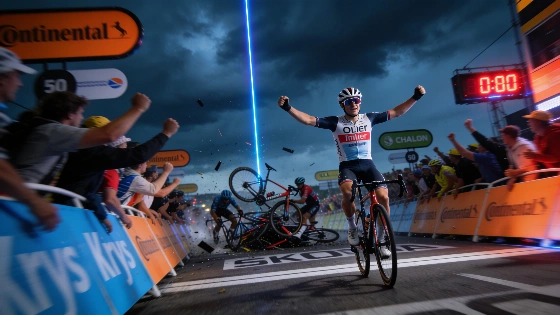
Tim Merlier delivered a commanding performance in Chalon, clinching his third sprint victory in this year’s Tour de France. The Belgian sprinter surged ahead in the final meters, leaving his competitors trailing by nearly a bike length, despite launching his sprint from a near standstill. The stage, marked as the last opportunity for sprinters, unfolded under heavy humidity and the threat of storms, adding to the tension on the road.
The day’s breakaway featured Damiano Caruso and Veistroffer, with Caruso’s presence recalling the scrutiny cyclists often face, including airport checks and suspicion over supplements. Veistroffer, known for his solo escapes, enjoyed brief attention before the peloton reeled in the fugitives. As the race approached Chalon, the peloton navigated late attacks and technical sections, with several riders attempting to disrupt the expected sprint finish.
In the final kilometer, chaos erupted when a high-speed crash occurred just 400 meters from the line. The incident, triggered by a wheel touch involving Gaviria, sent several riders to the ground at over 70 km/h. Gaviria was among the most seriously affected, while others managed to avoid major injury. Despite the crash, Merlier’s dominance was never in doubt, as the photofinish confirmed his clear margin of victory.
The finish line in Chalon, near the museum dedicated to Joseph Nicéphore Niépce, the inventor of photography, provided a symbolic backdrop. Modern technology captured Merlier’s win at 1,000 frames per second, a stark contrast to the hours-long exposures of Niépce’s era. The evolution of both cycling and photography was evident, highlighting how the sport has changed over the past two decades.
Veteran riders like Pedro Horrillo and Chris Froome, now serving as VIP drivers, reflected on the risks and transformations in cycling. Both have survived life-altering crashes, with Horrillo’s career ending after a fall in the 2009 Giro and Froome’s trajectory shifting following a training accident. Their conversations underscore the ever-present dangers and shifting landscape of professional cycling.
Julian Alaphilippe’s recent struggles were also on display. Once a contender among the sport’s elite, Alaphilippe has faced a steady decline since a severe crash in 2022. His performance in the stage to Nevers, where he finished last among the main group, highlighted the challenges faced by former champions as the peloton’s dynamics evolve.
As the Tour leaves the flatlands and enters the Vosges and Plateau de Salaison, the focus shifts to the climbers. Jonas Vingegaard will attempt to match Tadej Pogacar in the mountains, while younger riders continue their pursuit. Pogacar, unfazed by the historical significance of the upcoming climbs, remains focused on the decisive stages ahead, particularly the ascent to Haag near Markstein, where past battles have shaped the race’s outcome.
The unpredictable weather and tactical shifts have been a recurring theme in this year’s Tour. For a broader look at how sudden storms and sprint rivalries have influenced recent stages, see the analysis of a previous Chalon-sur-Saône stage at this detailed report on sprint battles and weather drama.
The Tour de France remains one of the most demanding events in world sport, with each stage bringing new challenges for riders and teams. The transition from flat sprints to mountainous terrain will test the endurance and strategy of all contenders. As the race enters its critical phase, the spotlight turns to the climbers and general classification hopefuls, while the sprinters reflect on a dramatic and eventful run through France’s varied landscapes.
For context, the Tour de France is the world’s most prestigious cycling race, attracting top athletes and global attention each July. The event’s mix of flat, hilly, and mountainous stages ensures a diverse set of challenges, with weather and road conditions often playing a decisive role. The 2026 edition continues to showcase the unpredictability and intensity that define the race, with Spanish and international fans closely following every development.