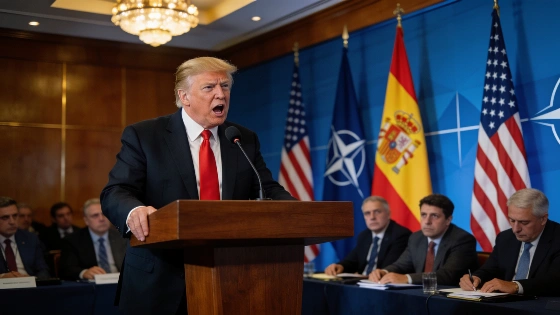
Donald Trump has ordered a halt to all US-Spain trade, citing Spain’s defense spending. The Spanish government responds, highlighting EU rules and the US trade surplus. The dispute raises new questions for bilateral relations.
Donald Trump has sharply intensified his criticism of Spain at the NATO summit in Ankara, announcing that he has instructed Treasury Secretary Scott Bessent to suspend all trade between the United States and Spain. The move comes after Trump labeled Spain a “terrible partner” within NATO, accusing the country of failing to contribute financially and refusing to support US military operations, particularly regarding the use of bases in Morón and Rota for actions against Iran.
During a press appearance alongside NATO Secretary General Mark Rutte, Trump did not hold back, describing Spain as a “lost cause” and stating he wants no further dealings with the country. He also accused the Spanish government of treating Rutte poorly and characterized Spain as openly hostile to increasing defense spending. Trump’s remarks follow similar threats made last year in The Hague, where he warned of “terrible tariffs” against Spain, though those measures were never implemented.
The Spanish government responded swiftly, issuing a prepared statement that downplayed the significance of Trump’s comments. According to La Moncloa, Spain maintains strong social, cultural, and economic ties with the United States and does not intend for that relationship to change. The statement also emphasized that the US currently enjoys a trade surplus with Spain, suggesting that American interests benefit more from the existing commercial relationship. Furthermore, Spanish officials pointed out that trade policy is managed at the European Union level, making it impossible to single out individual member states for punitive measures.
La Moncloa also highlighted that economic links between the two countries are primarily driven by private companies rather than government action. The Spanish government reiterated that bilateral relations with the US are mutually beneficial, both in commerce and defense cooperation. Despite Trump’s harsh language, including claims that Spain is particularly resistant to defense spending compared to other NATO members such as the United Kingdom, France, and Italy, Spanish authorities have sought to project calm and continuity.
Trump’s latest escalation adds to a series of recent diplomatic tensions involving Spain and other European allies. The dispute over defense contributions and military cooperation has become a recurring theme at NATO gatherings, with Trump repeatedly pressing for higher spending commitments from member states. The Spanish government’s insistence on EU-level decision-making reflects the broader complexities of transatlantic relations, where national and supranational interests often intersect.
For context, recent months have seen other high-profile political disputes in Spain, including cases involving senior officials and public trust. For example, the issue of accountability in government was highlighted when María Jesús Montero expressed regret over her trust in Vicente Fernández amid the Leire case investigation, as reported in coverage of the SEPI scandal. These developments underscore the ongoing challenges facing Spanish institutions both domestically and in their international partnerships.
Spain’s role within NATO and its economic ties to the US remain significant. According to official data, the US is one of Spain’s largest trading partners outside the EU, with bilateral trade encompassing a wide range of sectors from agriculture to technology. Any disruption to this relationship could have practical consequences for businesses and workers on both sides of the Atlantic. However, the EU’s collective trade policy framework means that unilateral action by the US would likely trigger a coordinated response from Brussels, rather than from Spain alone. The situation continues to evolve as both governments navigate the diplomatic fallout from Trump’s statements.