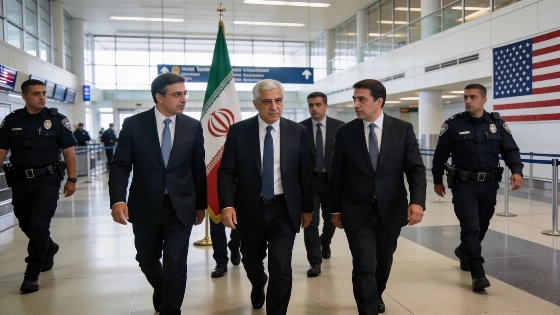
The US has approved visas for Iran’s president Masoud Pezeshkian and his team to attend the UN General Assembly in New York. The visit comes during a period of heightened conflict between Washington and Tehran. The Iranian delegation will be smaller than in previous years, and their movements in New York remain tightly controlled.
The Trump administration has approved travel for Iranian president Masoud Pezeshkian and his delegation to New York for the United Nations General Assembly. The decision comes as direct hostilities between the US and Iran continue, with the US and Israel’s military campaign against Iran still unresolved after more than six months.
The US State Department said that, as the UN’s host country, it is required to allow the main Iranian delegation to attend the High-Level Week. This year, the Iranian team will be smaller than in previous years. Last year, several Iranian press members were denied visas. The US has also set strict limits on the delegation’s activities in New York, including a ban on buying luxury goods. According to Al Jazeera and AP, the delegation includes President Masoud Pezeshkian and Foreign Minister Abbas Araghchi. US officials stressed that these measures are part of their obligations as host nation, not a sign of easing pressure on Iran.
"Until the last moment, there was uncertainty about President Pezeshkian's participation, as Tehran publicly stated he had not received his visa just days before the trip."
Pezeshkian is scheduled to address the General Assembly next Wednesday. Until recently, it was unclear if he would attend, as Tehran reported on Monday that he had not yet received his visa. The visit comes after failed peace talks and continued US efforts to pressure the Iranian government, which remains in power despite ongoing military action. Independent sources confirm that the visa decision was communicated only after Iranian officials had already raised concerns about delays.
The US and Iran do not have formal diplomatic relations, but Iran maintains accredited diplomats at the United Nations. Under the UN Headquarters Agreement, the US must allow entry and stay for official business, regardless of tensions between the two countries. Both the UN and US authorities have repeated that accreditation obliges the US to grant access for official UN work, even without diplomatic ties.
On the same day the US confirmed Iran’s attendance, China and Russia vetoed a US-backed resolution in the UN Security Council that would have extended the mandate of the expert panel overseeing sanctions on Iran’s nuclear program. The panel, set up in 2010, supports the committee that monitors embargoes on nuclear-related trade and arms with Iran. China and Russia voted against the renewal, while Pakistan and Somalia abstained. According to The News Pakistan and Straits Times, the final vote was 11 in favor, 2 against, and 2 abstentions. The panel’s mandate will expire on September 26.
Russia and China justified their vetoes by arguing that UN sanctions mechanisms on Iran were lifted as part of the 2015 nuclear deal, a position cited by several Western agencies as central to their decision.
The Iranian mission to the UN welcomed the vetoes by Beijing and Moscow and criticized the US-led resolution as politically motivated. In a statement on X, the mission accused the US and its allies of trying to manipulate the Security Council for their own interests, and praised Russia and China for defending the UN Charter.
Disputes over Iran’s nuclear activities and sanctions enforcement continue to shape international diplomacy. The current standoff at the Security Council echoes other recent disputes, such as those covered in this earlier report by RUSSPAIN, where vetoes and procedural hurdles have blocked consensus on sensitive issues.
The US decision to allow Pezeshkian’s entry, while keeping strict controls, reflects a practical approach to international obligations rather than any improvement in relations. The smaller Iranian delegation and ongoing restrictions show the continued mistrust and limits of diplomatic engagement. As the UN General Assembly meets, the conflict remains unresolved, and divisions in the Security Council make progress unlikely for now.