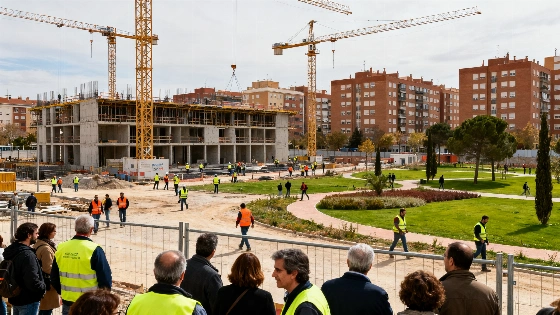
Madrid Launches Largest Residential Project: 51,000 New Flats and Dedicated Infrastructure. Construction has begun on Valdecarros in the Villa de Vallecas district — the largest residential development in Spain. Tens of thousands of new homes, schools, hospitals, parks, and modern transport links will be built here. Designed for 150,000 residents, the project is set to transform Madrid’s housing market.
In Villa de Vallecas, in the southeast of Madrid, construction is starting on Valdecarros — the largest residential project in the city's history. The plan includes over 51,000 apartments, about 55% of which will be classified as protected or social housing. Within three years, 28,000 apartments are scheduled for completion, and the first residents are expected to move in by 2029.
Valdecarros will cover an area of 19 million square meters — approximately 17 kilometers from the city center. The project is designed for 150,000 residents, comparable to the population of a large Spanish city. According to the project management, Valdecarros is conceived not as another dormitory district, but as a full-fledged 'city within a city' with developed infrastructure and jobs.
Scale and stages
Construction will proceed in phases: the district will be divided into eight stages to flexibly respond to demand. This approach prevents empty neighborhoods and gradually fills the area with housing and services. According to project data, Valdecarros will become Madrid’s largest reserve of affordable housing for the next twenty years.
Infrastructure and urban environment
The new area will feature schools, kindergartens, clinics, sports complexes, hospitals, office buildings, and commercial spaces. A total of 462,000 square meters is allocated for shops and cafés, including 175,000 on the ground floors of residential buildings. Special attention is given to the urban environment: wide sidewalks, gentle changes in elevation, green boulevards, and parks are designed to make the district convenient for living and strolling.
Green spaces and transport
About 7 million square meters of Valdecarros will be occupied by parks, squares, and alleys—almost 40% of the entire area. More than 110,000 trees are planned to be planted. For pedestrians and cyclists, 127 kilometers of paths will be created to minimize dependence on private vehicles. The project includes new transport hubs, integration with commuter trains, possible extension of metro lines, and the launch of Bus Rapid Transit services, which will offer metro-level service quality but operate on the surface.
Practical details for future residents
Those considering Valdecarros for buying or renting housing should note the timeline: the first apartments will be available in 2029, and large-scale occupancy is expected three years after construction begins. More than half of the housing will fall under protected categories, which is important for those seeking affordable options. The district promises developed infrastructure, transport accessibility, and a significant number of green spaces.
Financing and city involvement
The first stage of Valdecarros is already completed—with €6.5 million spent on it. The second phase started in November last year with a budget of €16.2 million. The third will connect to Cartagena de Indias Avenue. The city authorities own 36% of the land, emphasizing the public nature of the project. Madrid Mayor José Luis Martínez-Almeida notes that Valdecarros is key to solving the capital's housing problem and an important step toward sustainable urban development.
According to Talent24h, Valdecarros could serve as an example of a new approach to urban development in Spain, where the focus is not only on the quantity of housing but also on the quality of the urban environment.