Heavy rain has caused major flooding in Valencia and Barcelona. Emergency alerts were sent to residents. Schools in 15 Murcia towns are closed. Transport and airports are heavily disrupted.
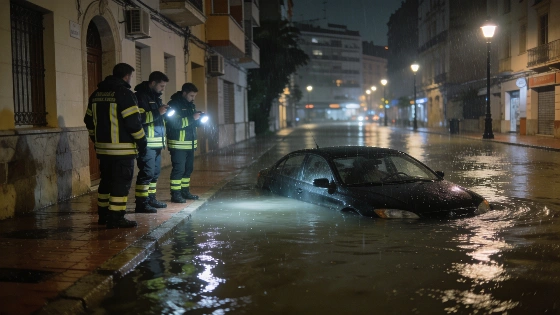
Flooding swept through Valencia and Barcelona on Wednesday night, prompting authorities to send urgent ES-Alert warnings to thousands of mobile phones and shut down schools and transport across the Mediterranean coast. Emergency services faced a surge of incidents as entire neighborhoods dealt with rising water and sudden disruption.
In central Valencia, the Centro de Coordinación de Emergencias activated the Plan Especial de Inundaciones after hours of heavy rain hit the city and its suburbs. The alert, sent at 22:08, told residents to avoid travel, stay away from riverbeds and ravines, and move to higher floors if water levels rose. The warning targeted the northern and southern coastal areas of the province, where flood risk was highest, according to the Generalitat Valenciana.
The municipality of Valencia had already activated orange-level emergency protocols and suspended outdoor sports events from 14:00 on September 15, ahead of the heaviest rainfall.
Rainfall totals were extreme in some areas. Torrent recorded over 90 liters per square meter in just 45 minutes, according to the mayor, who called the situation briefly critical. L'Eliana saw 85 liters, and Chiva, Riba-roja de Túria, Llíria, and Paterna also reported high accumulations. Emergency crews rescued people trapped in a fast-food restaurant, showing how quickly the flooding escalated. The Spanish State Meteorological Agency (AEMET) had issued orange warnings, forecasting up to 40 mm per hour and 80–120 mm in 2–3 hours, with possible hail and strong winds.
Transport struggled to cope. Adif reported delays on the C2 commuter rail line between Silla and Almussafes due to power failures. Metrovalencia had widespread delays and partial closures on lines 1 and 2. The airport in Manises closed temporarily, diverting 12 flights before reopening later in the evening. Travelers were told to check with airlines for updates as the situation changed. Independent reports confirmed that heavy rain caused major disruptions in Metrovalencia and at the airport, with operations halted and flights redirected.
Murcia took further precautions as forecasts worsened. The regional government suspended classes in 15 municipalities, including Águilas, Lorca, Cartagena, and Mazarrón, after the State Meteorological Agency raised the rainfall warning to orange, with up to 50 liters per square meter possible in an hour. Early childhood centers, day centers, and social services for the elderly and disabled were also closed to reduce movement and risk. The University of Cartagena stopped all in-person activities, including non-essential subcontracted work.
The severe weather episode was not isolated to Valencia and Murcia: Catalonia, including Barcelona and surrounding areas, was also under orange and yellow alerts, with forecasts of over 40 liters per square meter in 30 minutes and up to 90 liters in 3 hours. Authorities in several autonomous communities maintained heightened warnings into the night, anticipating further heavy rainfall.
President Pedro Sánchez urged the public to follow emergency service instructions and rely on official sources for updates. The Generalitat Valenciana repeated the call to avoid unnecessary travel and respect road closures. In southern Valencia, a pre-emergency yellow alert was declared for the Poyo-Saleta ravines, affecting several outlying districts.
The impact was immediate. Students, teachers, and staff in affected areas were told to stay home, with absences for force majeure considered justified. Schools that stayed open were told to accommodate students if teachers could not reach their posts. The government asked residents to monitor official websites and social media for updates.
Spain continues to face the challenges of extreme weather and its effect on daily life. The rapid escalation of alerts and the scale of the response show how vulnerable urban infrastructure is to sudden downpours. For more on how political and social crises can shift priorities in Spain, see this earlier breakdown.
This latest storm has exposed the limits of local preparedness and the need for fast, coordinated action. With schools closed, flights diverted, and public transport disrupted, the consequences are felt everywhere. The quick use of ES-Alert and emergency plans shows a system under strain but focused on protecting residents. This episode highlights how climate volatility is now a central challenge for Spain’s cities and regions, demanding vigilance, investment, and clear communication from authorities.