After a month-long strike, most Valencian teachers have turned down the regional government’s proposal. The dispute highlights ongoing problems with class sizes, resources, and a lack of trust between educators and officials.
Valencian education is at a standstill. After a month of indefinite strikes, 87% of participating teachers have rejected the regional government’s latest offer, making clear their lack of confidence in those in charge. The government’s focus on ideological controls and reducing the use of Valencian in schools has only widened the gap between teachers and policymakers.
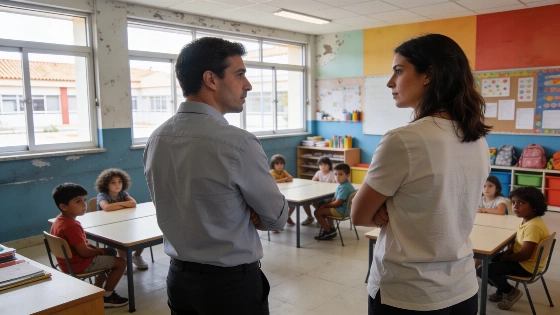
Many of the same problems have lingered for decades: crowded classrooms, not enough staff, old buildings, and too few resources for a student body that keeps getting more diverse. In the 1980s, teachers pushed to bring class sizes down from forty to thirty. Today, the demands are more complicated. Schools are expected to do more, but the support hasn’t kept up.
According to Spain’s Ministry of Education, the Valencian Community has one of the highest rates of early school leaving in the country, with figures exceeding 15% in recent years.
Between 2015 and 2023, the Botànic coalition made some progress: more staff, smaller classes, expanded early childhood education, and programs like XarxaLlibres and Edificant to address infrastructure problems. Still, gaps remained—some reforms needed more time or money, and not every decision worked out. The current government, led by the Partido Popular since 2023, inherited these issues but has shifted its attention away from the daily realities in schools.
Instead of building on earlier gains, the new administration has pushed the so-called Ley de Libertad Educativa. Critics say this law sidelines the Valencian language and puts inspectors in charge of enforcing a vague idea of ideological neutrality. Many teachers now feel watched rather than supported, making it even harder to rebuild trust.
Some problems are still unresolved. The Conselleria warns that reducing class sizes in early childhood could mean losing 60% of places for children aged 0 to 3. But public schools have shown that assigning two professionals per group—one teacher and one early childhood educator—can improve care without cutting spots. The real issue is money: quality costs, and excuses don’t help.
A 2023 report by El País highlighted that, despite increased investment in infrastructure and staff over the past decade, many Valencian schools still operate in temporary buildings known as 'barracones', with over 400 such units in use as of early 2024. This ongoing reliance on provisional classrooms underscores the depth of the region’s educational infrastructure challenges.
Inclusive education faces similar obstacles. Putting students with special needs in regular classrooms isn’t enough. Schools need specialist staff in therapeutic pedagogy, speech and language, extra guidance, and, when needed, more educators and support workers. Real inclusion also depends on stable teams, time to coordinate, and strong ties with families and outside services.
Every government has to answer for what it does, not just what it inherits. The Partido Popular has now been in charge for over three years. The problems it faces—and the conflicts it hasn’t solved—are now its responsibility. As seen in recent disputes elsewhere, unresolved staff issues can bring public services to a halt.
Valencian schools are expected to deliver good academic results, lower dropout rates, tackle inequality, support inclusion, fight bullying and cyberbullying, integrate technology, and respond to the challenges of artificial intelligence. But resources, time, and support are still in short supply. The debate over class sizes is telling: numbers have improved since 1985, but class size still matters for quality, and solutions need to fit each stage and school.
Pausing the strike in June didn’t solve the conflict. To rebuild trust, the Conselleria needs to show real progress on class sizes, staffing, pay, working conditions, inclusion, cutting bureaucracy, and fixing infrastructure. The government also needs to drop the requirement for ideological monitoring by inspectors. Announcements and recycled measures aren’t enough—what’s needed are real agreements, clear timelines, budgets, and follow-through.
Education in Valencia doesn’t start over with each election. Progress means matching new responsibilities with real resources, reducing class sizes without cutting places, guaranteeing specialist support, and backing public schools and their teachers. A government that keeps resources tight and treats educators with suspicion isn’t moving forward. The start of the school year will show whether the authorities have learned this—or if the crisis will get worse.
Spain’s education system has long struggled to balance reform and continuity. Each administration promises change, but the real test is whether it can deliver lasting improvements for students and teachers. The situation in Valencia shows that without investment, trust, and attention to what happens in classrooms, even the best intentions fall short. The next few months will show if the government can restore confidence or if the standoff will become the new normal.