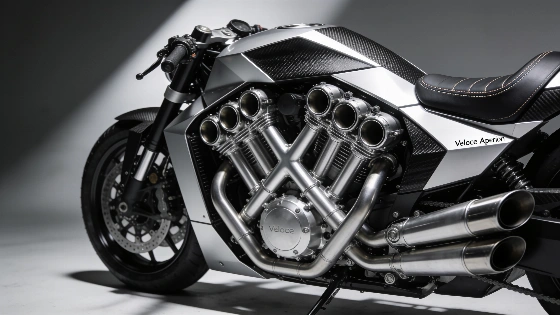
British startup Veloce Motorcycle has introduced the Aperion, powered by an eight-cylinder, two-stroke engine assembled from Aprilia RS125 components. Veloce quotes output at 280 horsepower at 12,000 rpm. The limited-production model costs €90,000, with a planned run of 24 motorcycles.
Two-stroke engines have largely disappeared from mainstream European road-bike production as emissions requirements have tightened and four-stroke designs have become the norm. The Aperion revives the configuration in an unusual form: its eight cylinders sit in an X layout, described as two intertwined four-cylinder boxer engines. Its stated output of 280 horsepower and weight of 160 kilograms give it a power-to-weight ratio of 1.75 horsepower per kilogram, based on those figures.
The Aprilia RS125 name covers markedly different generations. The earlier model used a liquid-cooled, single-cylinder two-stroke engine; a technical history by Espíritu RACER Moto puts the unrestricted 2006 version at about 28 horsepower and earlier versions at roughly 34 horsepower. The 2007 Euro 3 transition brought tighter emissions equipment and output below 30 horsepower, information from that account. The two-stroke RS125 remained in Aprilia’s range until 2012, when the four-stroke RS4 125 succeeded it. Later, the RS125 made from 2017 to 2023 used a four-stroke single rated at 15 horsepower at 10,500 rpm and 8 lb-ft of torque at 8,250 rpm. That history shows why the donor engine’s generation matters when describing the Aperion’s components.
Engineering Without Compromise
The Aperion’s engine is an ambitious mechanical package. Eight pistons operate in four pairs, with eight 24-millimeter Dellorto carburetors supplying the fuel-and-oil mixture. A custom spiral throttle mechanism synchronizes the carburetors. Eight independent exhaust pipes, each shaped using industrial 3D metal printing and laser sintering, route around the engine.
Veloce built the front and rear subframes from welded steel tubing, with the engine serving as a stressed member of the chassis. The rear swingarm is a single-sided aluminum unit paired with a monoshock. The front suspension and brakes come from a Suzuki GSX-R, including radial-mount Tokico calipers and lightweight alloy wheels. Minimalist bodywork combines a long fuel tank, leather seat, simple tail section and single headlight. The design omits fenders, license-plate holders and reflectors.
Performance and Exclusivity
At a stated 160 kilograms, the Aperion pairs its claimed 280 horsepower with a reported power-to-weight ratio of 1.75 horsepower per kilogram. Its high-revving two-stroke X8 layout promises a distinctive engine note and power delivery. A planned run of 24 bikes and a €90,000 price make it an exclusive, low-volume machine, with deliveries expected to begin next year.
The engineering challenge extends beyond packaging and power. The UK Driver and Vehicle Standards Agency’s Vehicle Market Surveillance Unit says motorcycles are assessed against Euro 5 requirements as adopted in Great Britain, using laboratory testing under the World Motorcycle Test Cycle. For the relevant motorcycle category, the programme sets a carbon monoxide limit of 1,000 mg/km and a total hydrocarbons limit of 100 mg/km. The non-methane hydrocarbons limit is 68 mg/km, while the nitrogen oxides limit is 60 mg/km. The agency describes its purpose this way: “DVSA tested every vehicle to make sure they all conformed to European emission standards (as adopted in GB legislation).” Those limits help explain why high-output, carbureted two-strokes are rare in contemporary road-bike production.
The regulatory shift is reflected in the RS125’s own history: Espíritu RACER Moto traces its output from roughly 34 horsepower in earlier versions to about 28 horsepower in the unrestricted 2006 model, followed by Euro 3 changes in 2007. That account dates the end of the two-stroke RS125’s run to 2012, when Aprilia replaced it with the four-stroke RS4 125. The Aperion draws on the earlier two-stroke lineage, combining it with a multi-cylinder layout and modern manufacturing methods as the wider motorcycle industry moves toward electrification and tighter emissions standards.