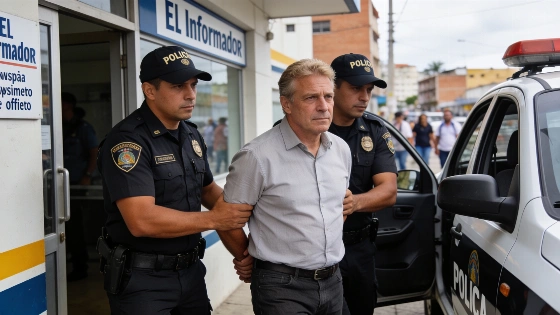
Javier Oropeza, ex-mayor of Torres, was arrested in Barquisimeto just after returning from exile in Spain. The move comes as US-backed talks on political transition begin. Opposition leaders demand his immediate release.
Javier Oropeza, the former mayor of Torres, was arrested in Barquisimeto shortly after coming back to Venezuela from two years in exile in Spain. He was detained at the offices of El Informador newspaper, just a day after a Venezuelan court dropped all charges that had forced him to leave the country, according to El Nacional.
Oropeza's arrest happened as a new round of US-brokered talks between the Venezuelan government and opposition was set to begin. The talks are focused on civil and political rights, including freedom of expression—issues brought into sharper focus by his detention. Several independent Spanish-language outlets reported that uniformed officers took Oropeza, and his location was not immediately known.
Javier Oropeza returned to Venezuela from more than two years of exile in Spain on September 16, and was arrested less than 24 hours later.
The Plataforma Unitaria Democrática (PUD), Venezuela’s main opposition coalition, called for Oropeza’s immediate release, pointing out that his legal case had been dismissed the day before. Corina Machado, a leading opposition figure and Nobel laureate, criticized the government’s actions and described them as typical of the current administration under acting president Delcy Rodríguez. She said these moves only increase public anger and insisted that justice would prevail. According to La Nación, Machado accused authorities of "kidnapping" Oropeza and demanded urgent information about his whereabouts.
Other opposition groups, including Voluntad Popular and Vente Venezuela, also demanded transparency about Oropeza’s location and called for his release. Vente Venezuela’s Human Rights Committee said agents from the National Police’s Penal Investigation Division carried out the arrest and warned that political persecution continues under Rodríguez. Both parties described the arrest as politically motivated and pressed for immediate disclosure of Oropeza’s status.
International attention on Venezuela’s security forces remains high. The UN’s Independent International Fact-Finding Mission on Venezuela recently reported that, despite some limited improvements, the state’s repressive apparatus is still in place. EFE and Infobae noted that Oropeza’s arrest happened as the second round of negotiations between the government and opposition began, with judicial reforms and civil rights guarantees on the agenda.
The first round of government-opposition talks concluded on August 12, with the second round—focused on Supreme Court reform and political guarantees—beginning on September 17, the same day as Oropeza’s arrest. This overlap has heightened the political sensitivity of the case.
Diplomatic efforts are also underway. US President Donald Trump is seeking a meeting with Delcy Rodríguez during the upcoming UN General Assembly in New York. If it happens, it would be the first direct meeting between a US president and a Venezuelan leader in over a decade, following the US-backed ouster of Nicolás Maduro and the restoration of diplomatic ties with Rodríguez’s government. The recent oil agreement giving the US control over a large share of Venezuela’s crude reserves has already sparked debate about Washington’s real intentions regarding democratic transition in the country.
As noted in a previous investigation, the overlap of political power and law enforcement remains a flashpoint in Latin America, with high-profile arrests often coinciding with sensitive negotiations or changes in leadership.
The timing and manner of Oropeza’s arrest highlight the ongoing volatility of Venezuela’s political situation. Despite official talk of dialogue and legal reform, state repression continues, and opposition figures still face immediate risks when returning from exile. For observers of Venezuela’s political process, this case shows the gap between official statements and the reality on the ground.