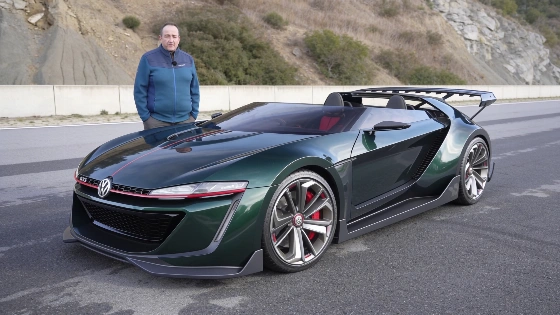
Volkswagen turned a virtual concept from Gran Turismo 6 into a real, radical roadster. With a 503 HP V6 biturbo, 4MOTION, and a top speed of 309 km/h, the GTI Roadster Vision Gran Turismo pushes the Golf GTI legacy to its wildest limits.
Volkswagen’s GTI Roadster Vision Gran Turismo is not a car designed for the showroom or the street. It is a bold experiment, a physical manifestation of what happens when engineers are given free rein to chase an idea to its logical—and illogical—extreme. Originally created for Gran Turismo 6 on PlayStation 3, this concept was never meant to leave the digital world. Yet Volkswagen broke with tradition, building a real-life prototype that challenges every expectation of the GTI badge.
The GTI Roadster is a two-seat, open-top machine that shares little visually with the familiar Golf GTI. The only clear connection is the emblem and a hint of the original spirit. Everything else is pure provocation: a low, wide stance, exaggerated wheel arches, razor-thin mirrors, aggressive side intakes, and a rear wing that makes no attempt to blend in. This is not a car for subtlety or everyday practicality—it is a statement of intent, a fantasy rendered in carbon and steel.
Beneath the dramatic bodywork, there are echoes of Volkswagen’s technical DNA. The 4MOTION all-wheel-drive system recalls the Golf R, and the seven-speed DSG gearbox is a familiar piece of the brand’s engineering. But the heart of the Roadster is something else entirely: a 3.0-liter V6 biturbo engine, developed specifically for this project, delivering 503 HP and 560 Nm of torque. With a weight of just 1,420 kg, the car accelerates from 0 to 100 km/h in 3.6 seconds and reaches a top speed of 309 km/h—numbers that make even the fastest production Golf GTI seem tame by comparison.
Driving the GTI Roadster Vision Gran Turismo is an experience far removed from any console simulation. The open cockpit fills with the roar of the six-cylinder engine, the wind lashes at your face, and every surge of acceleration is a reminder that this is no digital fantasy. The cockpit is stripped for purpose: digital instruments, carbon fiber accents, and a Formula 1-inspired steering wheel with paddle shifters and minimal controls. There is no luxury here—only focus and intent.
Yet, as a real-world car, the Roadster is unapologetically impractical. It was never intended for mass production or daily use. Its value lies in its very lack of compromise. Volkswagen built it to show that the Golf GTI, even as a concept, could be pushed far beyond the boundaries of a sensible hot hatch. The project was born from a request by Sony for a special model in Gran Turismo 6, and Volkswagen responded with a creation that later appeared in physical form at Wörthersee, the legendary gathering for GTI enthusiasts.
What sets the GTI Roadster apart is its journey from pixels to pavement. It is more than a design study—it is a demonstration of emotional engineering, a celebration of what happens when rules are set aside. The car does not compete with the Golf GTI Clubsport, the Golf R, or any future electric sports model. It occupies a different space entirely: the realm of the impossible, where imagination takes precedence over logic.
This project also highlights a moment of transition in the automotive world. As the industry moves toward electrification, software, and shared platforms, the existence of a 503 HP V6 biturbo convertible feels almost rebellious. It is a reminder of what performance once meant, and why some cars are memorable precisely because they are unique, imperfect, and a little bit reckless.
For those interested in how the Golf GTI stacks up against other compact icons, a recent comparison of the VW Golf, Kia K4, and Mazda3 explores how these models define the segment after the latest Golf update. The analysis, available here, puts the enduring appeal of the GTI into a broader context.
The Volkswagen GTI Roadster Vision Gran Turismo will never reach production, and perhaps that is for the best. Its allure lies in its singularity—a controlled madness, a tribute to fans, and a reminder that sometimes, the most memorable cars are those that exist simply because someone dared to ask, "why not?"
Contextually, the GTI Roadster Vision Gran Turismo stands as a rare example of a digital concept made real, joining a select group of vehicles that have crossed from virtual to physical form. Its creation underscores the enduring power of the GTI name and the willingness of major manufacturers to experiment, even as the industry faces rapid change. For enthusiasts, it is a symbol of what is possible when imagination is given the green light.