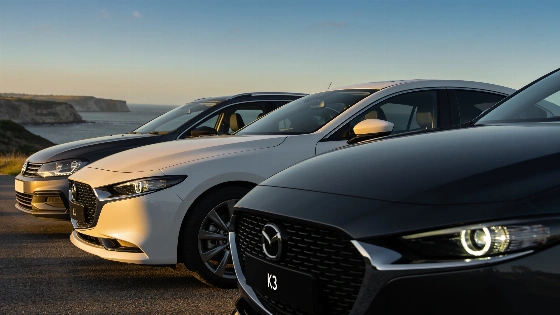
The VW Golf, Kia K4 and Mazda3 each promise a different take on the modern compact. After a major update for the Golf, can its rivals finally dethrone the segment’s icon? Here’s how they compare on design, comfort, practicality and driving experience.
When the eighth-generation VW Golf arrived, it faced skepticism from loyalists who felt the icon had lost some of its edge. Now, after a significant 2024 refresh, the Golf finds itself up against two ambitious contenders: the all-new Kia K4 and the established Mazda3. Each brings a distinct approach to the compact hatchback formula, but only one can claim the top spot.
Interior and Comfort
The Mazda3, now in its fourth generation since 2019, stands out as the most mature design in this trio. Its cabin, with circular digital gauges, leather-trimmed surfaces and a tactile rotary controller, feels almost retro compared to its rivals. Ergonomics are generally solid, though some quirks remain. The front seats, however, lack lateral support and seem best suited for slimmer, shorter occupants. Rear access is tight, and space for knees is limited—an aesthetic rear design that comes at the cost of practicality.
Kia’s K4, launched in 2024 as the Ceed’s successor, makes a bold statement with its styling and interior layout. The driving position is notably high, and the seats are firm. While rear legroom is generous, foot space under the front seats is restricted. The climate controls are managed via a dedicated screen, but its placement means the steering wheel can partially obscure it while driving. Some controls, like the heated steering wheel button on the door, require a learning curve, and the main menu is cluttered with rarely used features.
The Golf, meanwhile, has addressed many of the usability complaints from earlier in its eighth generation. Physical buttons have returned to the steering wheel, replacing the much-criticized touch controls. The infotainment menus are now more logically organized and responsive. The standout feature remains the ergoActive seats, which offer the best comfort and adjustability in this group. Rear passengers in the Golf enjoy ample space, with only a slightly upright seatback as a minor drawback.
Cargo and Practicality
Despite being the shortest car here, the VW Golf surprises with the largest maximum boot capacity: 1,237 liters with the rear seats folded, and 381 liters in standard configuration. The Kia K4 follows closely, offering 438 liters (up to 1,217 liters), rivaling some estate cars. The Mazda3 lags behind, with a boot ranging from 351 to 1,026 liters, and lacks practical touches like cargo tie-downs. Its rear space feels more like a supermini than a true compact hatchback.
Engines and Efficiency
Under the bonnet, each car takes a different path. The Kia K4’s 1.6 T-GDI turbo engine delivers a lively character but can be abrupt when pulling away, especially in wet conditions where traction becomes an issue. It’s also the thirstiest, averaging 6.8 liters per 100 km in mixed driving and rising to 8.5 liters on the motorway. With a 47-liter tank, high-speed range is limited to around 553 km. On the upside, the K4’s ride is firm yet comfortable, and it’s packed with driver assistance tech, though its refinement still trails the Golf.
The Mazda3 opts for a naturally aspirated 2.5-liter engine, offering smooth, linear power delivery. The long gearing means acceleration feels less urgent than the numbers suggest, but cruising at 140 km/h sees the engine spinning at just 3,000 rpm. Impressively, it manages a test average of 6.2 liters per 100 km, showing that larger displacement doesn’t always mean higher fuel consumption. Like the Golf, it features cylinder deactivation under light loads, and notably, Mazda continues to forgo a gasoline particulate filter.
The Golf’s 1.5 eTSI mild-hybrid system is the most efficient of the trio, returning 5.8 liters per 100 km in real-world testing. The DSG gearbox shifts seamlessly, and the car feels agile and composed, aided by a rigid chassis and optional adaptive dampers. The micro-hybrid setup delivers brisk response, only sounding strained at high revs. With a tight 10.8-meter turning circle, the Golf is also the easiest to maneuver in city traffic.
On the Road
Driving dynamics set the Golf apart. Its steering is precise and progressive, making the car feel smaller and more nimble than its dimensions suggest. Road and wind noise are well suppressed, and the suspension—especially with adaptive dampers—offers a broad range of comfort and control. The Mazda3, by contrast, delivers a more understated sportiness, with direct steering and a firmer ride that suits winding roads. The Kia K4 feels stable and comfortable, but its handling and refinement don’t quite match the Golf’s polish.
All three cars use mild-hybrid technology and perform similarly in braking tests, stopping from 100 km/h in 34–35 meters. None leaves a poor impression in this regard.
Verdict and Context
Ranking third, the Mazda3 Skyactiv-G 140 appeals to those seeking individuality and a touch of quirkiness, but its limited space and aging interior hold it back (AUTO BILD score: 8). The Kia K4 1.6 T-GDI secures second place, offering plenty of tech and room, but is let down by high fuel consumption and a lack of standout features (score: 8.1). The VW Golf 1.5 eTSI reclaims its crown with a balanced, refined package and few real weaknesses (score: 8.7).
For readers interested in how Mazda is navigating the future of combustion engines, the upcoming fifth-generation MX-5 may mark a turning point for the brand’s iconic roadster. More details can be found in this analysis of Mazda’s plans for the last gasoline-powered Miata.
In summary, the latest Golf update has restored much of the model’s appeal, combining efficiency, comfort and everyday usability. The Kia K4 impresses with space and technology, while the Mazda3 remains a stylish outlier. For buyers in Spain and across Europe, these differences may tip the balance depending on personal priorities, but the Golf’s all-round strengths keep it at the top of the compact class for now.