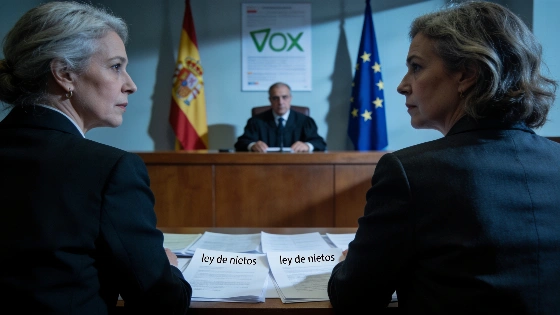
Vox has taken legal action against two senior Justice Ministry officials, accusing them of serious crimes over the application of the 'ley de nietos'. The move intensifies the political and legal battle over Spanish citizenship for descendants of exiles.
Vox has escalated its legal campaign against the Spanish government's handling of the 'ley de nietos', filing criminal complaints against two high-ranking officials in the Ministry of Justice. The party accuses María Ester Pérez Jerez, current Director General of Legal Security and Public Faith, and her predecessor Sofía Puente Santiago, now Secretary General for Innovation and Quality in Public Justice Services, of legislative usurpation and administrative misconduct. Both charges carry significant penalties, including potential prison time and lengthy bans from public office.
This marks the first time Vox has targeted senior ministry officials directly, rather than focusing on the prime minister or cabinet members. The complaints center on two official instructions signed by Pérez Jerez and Puente Santiago, which set out how the 'ley de nietos'—a provision within the Democratic Memory Law—should be implemented. Vox argues these instructions unlawfully expanded the law's scope, effectively bypassing parliamentary authority.
One of the contested instructions, issued by Puente Santiago in October 2022, presumed exile status for all Spaniards who left the country between July 1936 and December 1955, covering the Civil War and its aftermath. This broadened access to Spanish citizenship for foreign-born children and grandchildren of Spanish exiles, aligning with the Democratic Memory Law's aim to extend the reach of the 2007 Historical Memory Law. The second instruction, from November 2024, allowed applicants who filed for citizenship before the October 2025 deadline to submit missing documents later, provided they had used official online tools to register their applications.
Vox claims these measures amount to a covert rewriting of the law, stripping parliament of its legislative role. The party has also formally requested the State Secretariat for Justice to annul both instructions, warning it will appeal to the National Court if its demand is ignored. This legal offensive is part of a broader strategy by Vox to halt or reverse the expansion of citizenship rights under the Democratic Memory framework.
In parallel, Vox has announced plans to take the Central Electoral Board (JEC) to the Supreme Court after the JEC refused to suspend postal voting rights for Spaniards living abroad. The party's complaint references a dissenting opinion from three JEC members, who argued that the 2022 instruction included provisions contrary to the law it was meant to enforce, but that the Board lacked the authority to intervene despite recognizing possible illegality.
Vox has also appealed to the European Commission, urging it to launch infringement proceedings against Spain for allegedly granting EU citizenship en masse without sufficient ties or security checks, again citing the 'ley de nietos'.
This legal and political dispute over the 'ley de nietos' reflects broader tensions in Spain regarding historical memory, citizenship, and the role of administrative bodies in interpreting legislation. Similar controversies have arisen in recent years, such as the legal challenges faced by Catalan leaders over the application of amnesty laws, as seen in the case where Catalan officials contested a Tribunal de Cuentas decision on the grounds of conflicting interpretations of EU and Spanish law.
The Democratic Memory Law, enacted in 2022, was designed to address the legacy of the Civil War and Francoist repression, including provisions for descendants of exiles to reclaim Spanish nationality. The law's implementation has sparked debate over the balance between historical justice and legal certainty, with critics warning of administrative overreach and supporters emphasizing the need to redress past injustices. The outcome of Vox's legal actions could have significant implications for thousands of families seeking Spanish citizenship and for the future interpretation of memory laws in Spain.