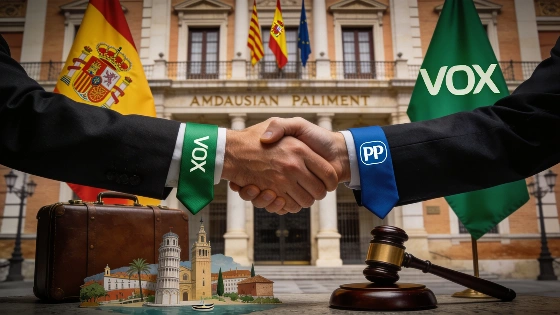
Vox secures a powerful vice-presidency in Andalusia, taking over tourism, justice, and local administration. The move gives the party a high-profile platform ahead of municipal elections and reshapes the regional power balance.
Vox has secured a pivotal role in the new Andalusian government, taking charge of the influential tourism sector as well as justice and local administration, following a coalition agreement with the Partido Popular (PP). The deal grants Vox a vice-presidency and a consolidated ministry, positioning the party for increased visibility just months before the next municipal elections.
The agreement comes after Juan Manuel Moreno, the PP candidate, fell just short of an absolute majority in the recent Andalusian elections, winning 53 seats out of the 55 needed. Despite Vox achieving the weakest result among the four recent regional elections, the party has leveraged its position to extract significant concessions from the PP. Notably, Vox will oversee tourism—a sector central to Andalusia’s economy—alongside justice, local administration, and deregulation, the latter inspired by Argentine policies and already present in other Vox-influenced regional governments.
Manuel Gavira, Vox’s candidate, will head the new super-ministry, mirroring a previous arrangement when Ciudadanos held a similar portfolio under Juan Marín. However, unlike Ciudadanos, which managed four additional ministries, Vox will have only this single, but high-profile, post. The current PP-Vox alliance now commands a comfortable majority, unlike the previous PP-Ciudadanos coalition, which depended on Vox’s support.
The structure of the new government marks a departure from other regional deals. While PP leaders in Extremadura, Aragón, and Castilla y León retained control over agriculture, social services, and family affairs, Moreno is the first to hand justice and local administration to Vox. This shift is seen as a strategic move, potentially allowing Vox to strengthen its grassroots presence across Andalusia’s 785 municipalities ahead of the 2027 local elections.
Opinions among Andalusian administration insiders are divided. Some view the new Vox-led ministry as largely technical, offering limited public exposure, while others believe it will help the party build connections with the justice sector and local governments. The true impact will depend on the final distribution of responsibilities, which will be clarified in upcoming government decrees.
Currently, the justice and local administration ministry also manages juvenile justice, including programs for minors under judicial measures. Vox, which has previously linked immigrant minors to crime, has not commented on how it will approach these responsibilities.
Tourism, now under Vox’s control, is a political prize in Andalusia. In 2025, the region attracted nearly 38 million tourists, including local travelers, with the sector generating over €30 billion, peaking at more than 530,000 jobs in summer, and contributing 13% to the regional GDP. While Vox also holds tourism portfolios in Aragón and Castilla y León, the scale in Andalusia is unmatched. The party’s program calls for expanding tourism without penalizing visitors or the industry, despite ongoing debates about the sector’s social and economic impacts.
The tourism ministry is traditionally seen as a showcase role, previously held by junior coalition partners such as the Partido Andalucista, Izquierda Unida, and Ciudadanos. However, the sector faces challenges, including resident complaints and rising housing costs linked to short-term rentals. The Andalusian Association of Tourist Apartments has already welcomed the new arrangement, expressing readiness for constructive dialogue with Gavira’s department.
The opposition PSOE argues that the government’s design aims to limit Vox’s management scope to less contentious areas, while ensuring the party’s visibility through tourism and ideological influence via deregulation. Administration local, meanwhile, provides Gavira with opportunities to engage with municipalities across the region.
Andalusia’s political landscape is now set for a new phase, with Vox holding a single but strategically significant ministry. The coming months will reveal whether the party can translate this platform into broader electoral gains, as the region prepares for the next round of municipal elections.
For context, Andalusia is Spain’s most populous region and a major driver of the national tourism industry. The region’s political shifts often set trends for other parts of the country. The current coalition reflects broader changes in Spanish regional politics, where new alliances and power-sharing arrangements are reshaping traditional party dynamics. The outcome of this experiment will be closely watched both within Andalusia and across Spain, as parties test new strategies ahead of national and local votes.