VW Navarra will train 1,050 people for new weekend shifts without salary or contracts. The regional government is allocating one million euros for the program. Unions warn of exploitation and demand transparency.
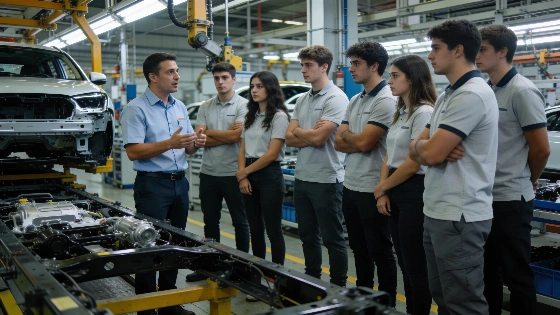
More than a thousand people, most of them young, will spend several weeks inside VW Navarra’s factory learning the basics for a new weekend shift—without pay or any employment contract. This is not a small internship program but a large operation, funded with one million euros of public money from the Government of Navarra, and set to begin in October as the company prepares for a major schedule change in 2027.
Regional president María Chivite has described the initiative as a “Capacitation Plan” after meetings with Volkswagen’s management. The ELA union has sharply criticized the plan, accusing both the government and Volkswagen of taking advantage of jobseekers’ vulnerable positions and using public funds to provide VW Navarra with a pool of unpaid, uncontracted labor under the label of training. ELA argues that this approach pushes Spanish labor law to its limits and weakens basic employment protections. According to the regional administration, the plan is part of a broader effort to prepare the local workforce for the automotive sector’s shift to electrification and new industrial demands.
The training program covers five distinct profiles for VW Navarra: line operators, installation drivers/operators, bodywork specialists, managerial staff, and technical specialists for indirect functions.
ELA representatives Igor Peñalver and Ioritz Pérez de Mendiguren say that candidates—selected by temporary work agencies like Nortempo, Manpower, and Adecco—will be under VW’s direct supervision for up to eight weeks, eight hours a day. Those aiming for skilled roles such as bodywork specialists, installation drivers, or electromechanics will complete a full theoretical and practical course. Production line candidates will have three weeks of training, including at least six days on the assembly line. None will receive pay or a formal contract during this period, only the promise of “future employability.”
ELA is demanding that proper contracts be issued for all trainees and wants the government to publish the full agreement and clarify where the million-euro subsidy comes from. The union is also considering a formal complaint to the Labor Inspectorate, depending on the company’s response. Meanwhile, UGT and CCOO, the two other major unions, have not commented. ELA believes this is because many of these trainees may eventually join their membership rolls with Volkswagen’s approval. Several independent reports estimate the total training volume at around 196,000 hours, showing the scale of the retraining effort rather than a one-off course.
The regional employment service (SNE) defends the plan as part of Navarra’s active employment policies, arguing that the automotive sector’s transformation—driven by electrification, digitalization, and innovation—requires new skills and quick workforce adaptation. SNE says that such training programs, which do not create a labor relationship or guarantee a contract, are standard in the sector and include support like transport subsidies or scholarships, but not salaries. The agency also notes that similar approaches are used in other fields with labor shortages, such as healthcare and renewable energy.
The government emphasizes that the plan is not limited to Volkswagen Navarra alone, but also includes separate training tracks for industrial operators and logistics operators working for VW suppliers, reflecting a broader strategy for the region's automotive cluster.
ELA argues that the training is unnecessary for many candidates, especially those with higher vocational qualifications, and that unpaid, contractless onboarding is a recent development. In the past, production workers would spend a single day in orientation before starting paid work on the line. Now, the union says, the scale of recruitment has turned the process into a business of its own, with public money passing through temporary agencies and no guarantee of a job at the end.
VW Navarra’s move comes as the company prepares to launch its weekend shift in January 2027, which will require a large number of new staff. The controversy echoes wider concerns about precarious labor practices in Spain’s industrial sector, as seen in previous reporting on migrant worker conditions in Valladolid.
While the SNE maintains that the plan is legal and necessary for competitiveness, the lack of transparency and the use of public funds for unpaid labor raise difficult questions. The government’s decision to subsidize a multinational’s recruitment pipeline without requiring basic employment guarantees blurs the line between training and exploitation. When public money is used to support corporate flexibility at the expense of workers’ rights, those seeking stable work are left to bear the risk and uncertainty.