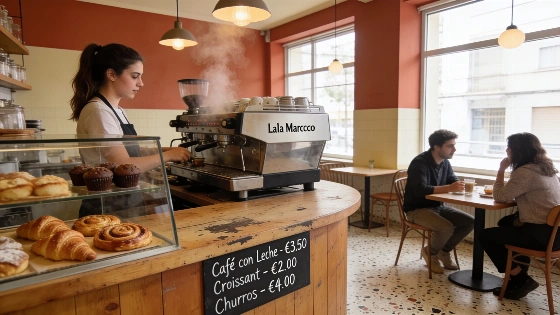
A specialty café in Viladecans, Barcelona, required €105,000 to launch. Owner Lorena reveals how much she earned, what she spent, and why breaking even is tougher than it looks. Her story offers a rare, detailed look at the economics behind Spain’s independent coffee scene.
When Lorena opened her specialty café in Viladecans, Barcelona, she knew the numbers would be tight. But after a year in business, the reality was even more demanding than expected: her café brought in €138,000 in revenue, yet only 8–9% of that—between €11,040 and €12,420—remained after covering all expenses.
Lorena’s journey began in Bristol, United Kingdom, where she first encountered specialty coffee. Returning to Spain, she trained as a barista, worked in several cafés, and eventually decided to invest in her own venture. The initial outlay was steep: €105,000 covered the transfer of the premises, renovations, and professional equipment, including a high-end espresso machine, grinders, oven, and dough mixers.
Monthly Revenue and Expenses
On average, the café generated between €11,500 and €12,000 per month. Fixed costs quickly ate into that figure. Rent, staff salaries, and social security contributions alone totaled €7,000–€7,500 monthly. Add to that €1,500 for coffee beans, €300 for fresh milk, and further spending on soft drinks, pastries, and other ingredients, and the total monthly outgoings reached €9,000–€10,000.
The business’s break-even point was set at €470 per day. Any day with lower sales meant the café was operating at a loss. Lorena noted that even with steady foot traffic, the margin for error was slim.
Licensing Hurdles and Investment Risks
Securing the right license proved more complicated than anticipated. The premises originally held a bakery license, not one for a café, which restricted the number of tables allowed. Lorena had to navigate additional bureaucracy and pay extra fees to adapt the license to her business model. Despite these challenges, she managed to repay her bank loan within the first year, though she had yet to recover her personal savings. If sales remained stable, she estimated it would take about three years to fully recoup her investment.
Margins: Coffee vs. Pastries
While coffee is the star attraction, it’s not the most profitable item. Each espresso cost Lorena about €0.55 and sold for €1.80, leaving a gross margin of €1.25 before overheads. In contrast, homemade cookies yielded a 40% margin, and commercial croissants reached 55%. During winter, daily cookie sales could hit 70 units, dropping to 10–20 in the summer months. Initially, Lorena sourced some doughs from a bakery, but she soon shifted to in-house production, upgrading her mixers to boost output.
Social Media and Daily Demands
Instagram and TikTok became essential tools for attracting customers. A video posted during the café’s opening drew a line out the door, and each new post about cookies or cinnamon rolls sparked fresh demand. Lorena’s workday started at 7 a.m., preparing coffee, baking pastries, and managing the kitchen. Despite having staff, she remained deeply involved in daily operations, with the café open six days a week.
Brand Evolution and Broader Context
The café launched as Bristol Koffee and, in February 2026, rebranded to Yellow Specialty Koffee, staying at the same Viladecans address. The financial figures Lorena shared reflect her first year in business, offering a rare, transparent look at the economics of Spain’s independent coffee sector.
Her experience echoes the challenges faced by many small business owners in Spain, where high fixed costs and regulatory hurdles can make profitability elusive. Stories of entrepreneurial grit, such as the journey of a top-rated Cabify driver in Madrid, highlight the persistence required to carve out a place in the Spanish service industry.
For those considering a similar path, Lorena’s story is a reminder: passion and preparation are essential, but so is a clear-eyed understanding of the financial realities behind the counter.