When a neighbor’s tree grows too close or its branches invade your garden, Spanish law offers clear but different solutions. The Civil Code sets specific rules for planting distances, pruning rights, and what you can do if roots cross onto your land. Here’s what every homeowner should know.
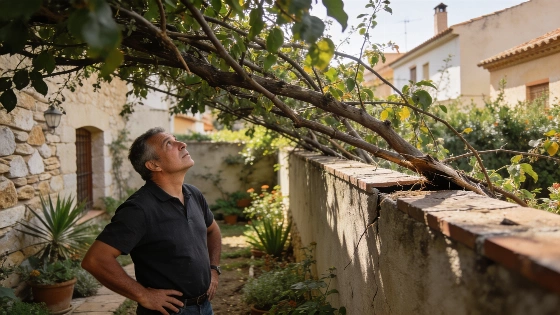
When a neighbor’s tree leans over your fence or its roots start creeping into your garden, the Spanish Civil Code provides a detailed framework for resolving these disputes. The law doesn’t treat all cases the same—how you can act depends on whether you’re dealing with branches, roots, or the tree’s location.
Articles 591, 592, and 593 of the Civil Code set out the main rules. If a tree is planted too close to the property line, the minimum distance is determined first by local ordinances or custom. If no such rule exists, the law requires at least two meters for tall trees and 50 centimeters for shrubs or small trees. If these distances aren’t respected, you have the right to demand the removal of the offending tree—but you cannot remove it yourself or enter your neighbor’s land without consent. The law only allows you to formally request its removal.
Branches and Roots: Different Rights
The law draws a sharp line between branches and roots. If branches from a neighbor’s tree extend over your property, you can require your neighbor to cut them back. However, you are not permitted to prune them yourself unless you have explicit permission. The right to act directly only applies to roots: if they invade your land, you may cut them yourself, but only within the boundaries of your own property. The law does not grant the same right for fallen leaves or other minor nuisances.
Shared Hedges and Boundary Trees
Article 593 addresses trees that form part of a shared hedge along the property line. These are presumed to be jointly owned, and either neighbor can request their removal. Still, the law does not allow one party to act unilaterally—removal must be agreed upon or formally requested. There’s an exception for trees that serve as boundary markers (mojones): these cannot be removed unless both owners agree, as they play a role in defining property limits.
What Homeowners Should Check
Before taking any action, property owners should identify which situation applies: Is the tree planted too close? Are branches overhanging? Are roots encroaching? Is the tree part of a shared hedge? It’s also essential to check for any local ordinances or established customs, as these take precedence over the general distances set by the Civil Code. The law prioritizes local rules, only applying the two-meter and 50-centimeter standards if no other guidance exists.
For those seeking more detail, the full legal text can be found in the consolidated version of the Código Civil. Understanding these distinctions is key to resolving neighbor disputes legally and avoiding unnecessary conflict.