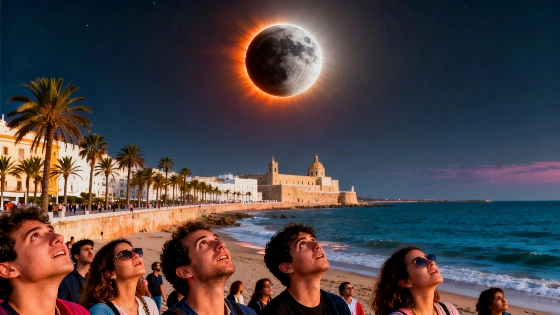
Partial and Total Solar Eclipse of 2027: Spain Prepares for a Unique Event. On August 2, 2027, Spain will witness a rare astronomical event—a total solar eclipse that will plunge the southern regions of the country into darkness for several minutes. In other areas, the phenomenon will be visible as a partial eclipse, but its dramatic impact will be felt across the entire nation.
On August 2, 2027, Spain will be at the center of one of the most remarkable astronomical events of the decade—a total solar eclipse that will pass through the southern regions of the country. According to the Instituto Geográfico Nacional, the full shadow of the Moon will cross the Strait of Gibraltar and cover cities such as Ceuta, Melilla, almost the entire province of Cádiz, a significant part of Málaga, as well as the southern areas of Granada and Almería. For these territories, the eclipse will be more than just a rare phenomenon: nearly five minutes of total darkness during the day is an event that occurs extremely rarely in Spain.
At the same time, even in regions where the total phase will not occur, the eclipse will still be visible. According to IGN calculations, in any part of the country, including the Canary Islands and the northern provinces, at least 70% of the Sun will be obscured. This means that millions of people across Spain will be able to witness an unusual dimming of daylight, and in southern cities—experience an almost complete night in the middle of the day.
Where and when darkness will fall
The maximum duration of the total phase is expected in Ceuta: here, the Moon will completely cover the Sun from 10:45 to 10:50 a.m., and darkness will last 4 minutes and 48 seconds. In Cádiz, the total phase will begin at approximately 10:45 a.m. and end after 2 minutes and 54 seconds, while in Málaga—from 10:48 a.m. and for just under two minutes. In other regions, the phenomenon will be partial but noticeable. Importantly, in Europe, the total phase of the eclipse will be visible only in Spain, whereas the partial eclipse will cover nearly the entire continent, as well as a significant part of Africa and southwest Asia.
In Egypt, where the eclipse will reach its maximum at 12:06 Spanish time, the total phase will last 6 minutes and 23 seconds—making it one of the longest eclipses of the 21st century. According to the US National Solar Observatory, the path of totality will cross Spain, Gibraltar, Morocco, Algeria, Tunisia, Libya, Egypt, Saudi Arabia, Yemen, and Somalia. This century, only the 2009 eclipse was longer.
Viewing safety
Watching a solar eclipse without special protection is dangerous for your eyesight. NASA emphasizes that you can only look at the Sun through certified glasses that meet the ISO 12312-2 standard. Ordinary sunglasses, even the darkest ones, do not provide adequate protection. You should also not use cameras, binoculars, or telescopes without special filters installed on the lens. The only exception is the brief phase of totality, when the Moon completely covers the Sun's disk, but even then, it's important to take precautions.
Ahead of the eclipse, the Spanish government has already approved a special plan to coordinate actions and inform the public. The authorities are preparing for an influx of tourists and increased interest in astronomical events, since Spain will soon experience three major eclipses: a total one in August 2026, another total in August 2027, and an annular eclipse in January 2028. After that, the next total solar eclipse in Spain won't occur until 2053.
Astronomical cycles and societal impact
The series of eclipses expected in Spain in the coming years is becoming not only a scientific event, but also a cultural one. Such phenomena have always attracted the interest of both astrologers and researchers of collective processes. The influence of rare astronomical events on public sentiment and personal decisions is discussed in other materials as well—for example, in the analysis of retrograde Pluto and the tension of ambitions, which can be found at the link on the influence of changes in astrological cycles.
Thus, the upcoming eclipse is not just a rare occurrence for astronomy enthusiasts, but an event capable of uniting the attention of millions, reminding us of the scale of natural processes and the importance of a scientific approach to their observation.