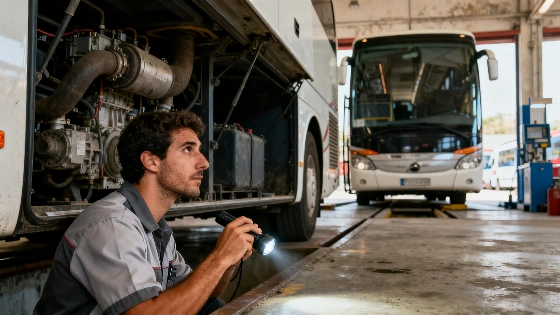
Key Reasons for Failures at the ITV and What This Means for Passengers. In Spain, nearly a third of buses and intercity coaches fail their technical inspection on the first attempt. The main reasons are vehicle age, wear and tear, and serious technical defects. This has a direct impact on the safety of millions of passengers.
In 2024, only 73% of Spanish buses and intercity coaches passed the mandatory ITV inspection on their first attempt. The remaining 27% were sent back for repairs due to serious technical defects. These figures are provided by AECA-ITV Association, analyzing the situation against the backdrop of increasing demand on public transportation.
The reasons for such a high failure rate stem from two key factors: the average age of Spanish buses exceeds 14 years, and their mileage often reaches half a million kilometers. Intensive use and outdated parts mean that the vehicles fail to meet even basic safety requirements.
Main technical issues
According to the Ministry of Industry and Tourism, buses and intercity coaches lag behind only trucks in terms of the number of defects. On average, each rejected bus has 2.7 serious faults—the highest rate among all categories of transport.
The most common reasons for rejection are brake system faults (15.7%), problems with the external condition of the bodywork (13.6%), excessive emissions (12.7%), defects in lighting and signaling (12.68%), and wear of the suspension, wheels and tires (11.8%). A separate category (17.6%) includes violations related to tachographs, speed limiters, and unauthorized modifications to the design.
Automotive expert Alfonso García (Motorman) notes that age and wear are the main enemies of safety. Over their years of service, the average bus in Spain travels almost 482,000 kilometers, and most serious accidents are linked precisely to outdated vehicles.
Safety and Accident Rates
According to a study by Carlos III University, the older the bus, the greater the risk of accidents and pollution levels. Vehicles over 11 years old are involved in traffic accidents more often, and their technical condition directly affects the safety of passengers and other road users.
In 2024, according to DGT data, the number of accidents involving buses rose to 2,855 cases compared to 2,662 the year before. Six bus passengers died over the year—twice as many as in 2019—and 77 people were seriously injured. This highlights the importance of regular inspections and fleet renewal.
Changes in Regulations and Recommendations
Starting January 1, 2024, Spain updated technical inspection criteria for buses: now special attention is paid to lighting and signaling systems. Any deviations in these areas can result in a failed inspection even for minor defects.
AECA-ITV advises transport companies and drivers to check brakes, lights, tires, suspension, emissions level, as well as tachograph and speed limiter functionality in advance. Special attention should be given to vehicles older than 11 years—they are most likely to fail the inspection on the first try.
The fine for an expired vehicle inspection ranges from 200 to 500 euros, and the cost of the inspection itself has risen by 8–10 euros over the past year due to increased energy tariffs.
Context and prospects
Spain transports more than 3.5 billion passengers by bus every year. Any technical failure in this sector is not just a matter of fines, but a real threat to millions of people. As AECA-ITV notes, maintaining the fleet in good condition is a key factor in road safety and reducing the number of accidents.