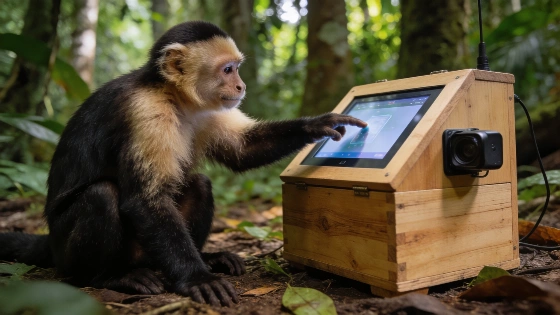
A simple wooden box with a touchscreen and AI camera is changing how scientists study wild capuchins. In just two weeks, eight monkeys figured out how to use the device for banana rewards, opening new doors for field research without removing animals from their habitat.
Eight wild capuchin monkeys in Costa Rica have learned to use a touchscreen powered by artificial intelligence, all for a piece of dried banana. This happened not in a lab, but in the rainforest, where researchers set up a wooden box with a camera, a touchscreen, and a food dispenser, then waited to see what the monkeys would do.
The device, called CapuchinAI, was built by teams from Emory University and the Georgia Institute of Technology. Their aim was to see if wild primates would interact with a machine on their own, learn how it worked, and generate useful data without being removed from their environment. After two weeks in the Taboga Forest Reserve, the answer was clear: at least some of the monkeys were eager to try.
Sixteen capuchins approached the box, ten managed to trigger a food reward, and eight figured out that touching the blue-lit screen meant a banana treat. The system’s AI, based on the YOLOv7 model and called MultipleCapuchins, could identify individual monkeys with over 97% accuracy using facial features. While the device isn’t yet running fully personalized tasks, it’s now possible to automate cognitive testing for wild animals in the field.
Unlike traditional animal cognition studies, which often require capturing and moving animals to labs, CapuchinAI lets the monkeys stay in their natural setting. They choose when to participate, how often to return, and whether to engage at all. This keeps their social dynamics and daily routines intact—something that’s hard to replicate in captivity.
The first experiment was simple: when the camera detected a capuchin, the screen showed a blue shape. A single touch released a slice of dried forest banana. For two days, the box sat untouched. Then a male named Trompudo broke the silence, hitting the box and eventually touching the screen. The food reward drew in other monkeys, and soon several were experimenting with the device.
Researchers saw a range of reactions. Some monkeys quickly understood the cause and effect, while others watched from a distance before trying it themselves. A few even used their mouths on the touchscreen, showing both adaptability and the unpredictable ways animals learn. These differences matter: automated field tests can reveal not just what a species can do, but how individuals vary in curiosity and problem-solving.
The study’s authors point out that success with the touchscreen doesn’t mean a monkey is more intelligent overall. Social rank, hunger, past experience, and willingness to approach new objects all play a part in who participates and how fast they learn. The technology is a tool for collecting data, not a final measure of intelligence.
CapuchinAI’s facial recognition already works well, but in this pilot, it mainly confirmed that a capuchin—not another animal—was present. The next step is to automate personalized tasks, so each monkey gets challenges suited to its history and skill level. Future tests will look at memory, impulse control, and cognitive flexibility, moving beyond the simple touch-for-food setup.
This approach is part of a wider trend in wildlife research: using technology to reduce human interference and improve data quality. A similar idea is behind the return of large mammals to Chernobyl’s exclusion zone, where the absence of people—not radiation—has allowed wildlife to thrive.
For now, CapuchinAI’s biggest achievement is practical. It shows that wild primates can take part in controlled experiments without leaving the forest. The device’s software can even limit rewards per animal, so dominant monkeys can’t take over. Still, the researchers say that no machine can replace the insights gained from long-term fieldwork and watching social behavior up close.
What’s striking is not just that the monkeys learned the task, but that technology is finally able to keep up with the complexity of animal lives. By meeting capuchins where they live, scientists are opening new ways to study cognition—ones that respect the unpredictability of real intelligence. The next challenge is scaling up: more animals, longer studies, and tasks that truly test what primate minds can do. For now, a handful of capuchins and a wooden box have shown that the future of animal cognition research may be in the forest, not the lab.