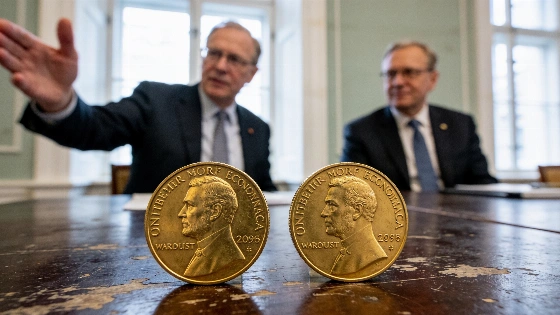
Michael Woodford and Robert E. Hall receive the economics Nobel for work on stabilizing economies. Their models trace how policy decisions shape household and business choices, and why central-bank communication can move markets.
A rate increase can curb demand, but its effect depends on what is pushing prices higher. Michael Woodford and Robert E. Hall have won the 2026 Nobel Prize in Economic Sciences for research that changed how governments and central banks try to steady the economy. Their work underpins models used to assess how monetary and fiscal decisions can cushion downturns or contain bubbles. The Nobel Prize announcement describes their contribution as developing the microeconomic foundations of macroeconomic stabilization.
The Royal Swedish Academy of Sciences recognized the two US economists for rebuilding stabilization theory around the decisions of households and businesses. Rather than treating economic measures in isolation, their models examine how people and firms react to policy and to what they expect policymakers to do next. The New York Times reported that the Academy stressed the link between individual choices and economy-wide outcomes. The approach helps policymakers respond to shocks and smooth business-cycle fluctuations.
The 2026 economics prize is worth 12 million Swedish kronor, shared between Robert E. Hall and Michael Woodford.
That shift puts central-bank communication inside the policy toolkit. The award highlights a framework in which policy is assessed partly through how households and firms respond to decisions and expectations. It supports the importance of communication in that mechanism, though the sources confirming the award do not present this as a separate official conclusion.
Woodford, a professor of political economy at Columbia University, argues that companies do not reset prices instantly. They may keep prices stable to retain customers, or adjust them as costs are redistributed. This rigidity gives central banks greater influence over real economic activity: interest-rate changes can affect demand while many prices remain unchanged. His work helped establish a theoretical framework for analyzing how interest rates and inflation expectations relate to output stabilization.
One numerical example in the article is hypothetical. If inflation is expected to rise from 3% to 4%, an increase of 100 basis points might not be enough. The example illustrates a 125-basis-point rise, from 2% to 3.25%, as a way to cool the economy. The award coverage and other materials summarized here do not independently verify this calculation. It should be read as an illustration, not a confirmed prescription.
Woodford’s influential book Interest and Prices: Foundations of a Theory of Monetary Policy set out a theoretical basis for modern analysis of monetary policy. It examines how interest rates and expectations relate to inflation and the stabilization of economic activity.
Applying that prescription gets harder when inflation comes from supply rather than excess demand. The article points to energy prices pushed up by the conflict involving Iran, but sources confirming the award do not independently verify that specific Iran-related energy dynamic. Higher rates could suppress demand too sharply and damage economic activity. Political pressure, including from Donald Trump, adds to the strain on central banks.
Woodford has said stabilization cannot be reduced to pulling policy levers without considering what households and businesses understand about those decisions. Announcements about future interest rates can shape expectations and influence economic choices. That fits the broader emphasis in modern macroeconomic models on how people and firms respond to policy.
Hall, a Stanford University professor and senior fellow at the Hoover Institution, was born in Palo Alto, California, in May 1943. His research examined consumption theory. It also covered the labor market and macroeconomics, helping lay foundations for modern macroeconomic analysis. Hall’s random-walk hypothesis challenged the Keynesian assumption that households consume according to current-year income alone. It also accounts for expectations about present and future income, along with access to credit, offering a more complex way to model household spending.
Hall also developed a flat-tax proposal. In the 1960s, he and his former wife, Berkeley economist Bronwyn Hall, created software to help economists run complex econometric calculations on large datasets. They marketed it as TSP in 1978. The tool became widely used. After the couple divorced in the 1980s, Bronwyn Hall took charge of the business.
The award revisits a long-running problem in economic policy. Keynesian stabilization measures called for lower interest rates and higher budget deficits during recessions, followed by restraint during booms. They lost credibility during the oil crises of the 1970s, when unemployment persisted alongside runaway inflation. The Academy says later models developed by Hall and Woodford helped restore the ability to assess how policy could stabilize economies. CNBC also reported that the 12-million-kronor prize is shared by the two laureates.
Woodford had already received the BBVA Foundation Frontiers of Knowledge Award and was widely considered a Nobel contender. Juan José Dolado, professor emeritus at Universidad Carlos III, argued that Spanish economist Jordi Galí should also have shared the prize because he contributed to the same theories. The Academy named Woodford and Hall as its two laureates.