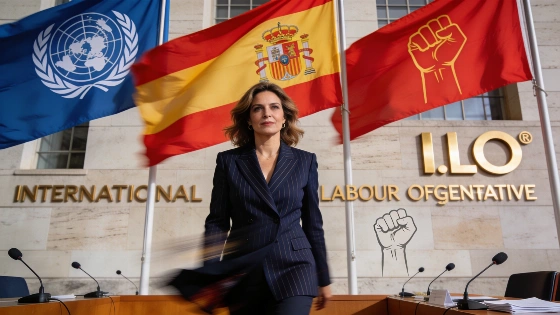
The Spanish government has officially nominated Yolanda Díaz to head the International Labour Organization. If elected, she would be the first woman and Spaniard in this role. The decision sets up a direct contest with current director Gilbert F. Houngbo.
The Spanish government has put forward Yolanda Díaz as its candidate for director general of the International Labour Organization (OIT), marking a significant move in international labour politics. The nomination, confirmed by La Moncloa and reported by EL PAÍS, positions Díaz, currently Spain’s second deputy prime minister and minister of labour, against incumbent Gilbert F. Houngbo, who has led the UN agency since 2022. If successful, Díaz would become both the first woman and the first Spaniard to lead the OIT.
This decision comes amid growing criticism from Spanish unions regarding the current direction of the OIT. Union leaders have voiced concerns about what they describe as a "Trumpist drift" under Houngbo’s leadership, a sentiment Díaz herself echoed during her recent speech at the OIT headquarters in Geneva. She argued that the organization is facing a crisis of mandate, emphasizing that if work is not a commodity, neither should be the institution representing it.
Following Díaz’s intervention in Geneva on June 9, speculation intensified about her potential candidacy. Although the Ministry of Labour initially declined to comment, the government’s official announcement has now clarified its position. While union leaders stated they did not directly request Díaz to run, sources within the major Spanish unions have described her as a strong choice for the role.
Prime Minister Pedro Sánchez publicly endorsed Díaz’s candidacy, highlighting her track record in defending labour rights and promoting social dialogue in Spain. Díaz herself confirmed her nomination on social media, expressing pride in representing Spain, Europe, the Global South, and the international community through this candidacy.
The selection process for the OIT’s top post involves 56 votes distributed among government representatives from 28 countries, 14 union delegates, and 14 employer representatives. This tripartite structure means that support from both labour and business sectors will be crucial. While Díaz is expected to receive significant backing from union representatives, sources suggest that employer delegates may be less supportive due to her interventionist stance on labour market issues. Some union votes may also go to Houngbo, but Díaz is seen as likely to secure the majority of labour support.
Other candidates could still enter the race until August 14, but as of now, the contest is expected to be between Díaz and Houngbo. The final vote is scheduled for November 16, with the new director general set to take office in November 2027. Should Díaz win, she is expected to remain in her current government roles until the transition.
This high-profile nomination comes at a time when Spanish political figures are increasingly visible on the international stage. Recent developments, such as scrutiny over PSOE leadership roles, have highlighted the evolving landscape of Spanish politics and its influence abroad. For example, ongoing debates about party leadership and internal tensions were recently explored in an article on questions surrounding PSOE figures and Pedro Sánchez.
The OIT, founded in 1919, is the only UN agency with a tripartite governance structure, giving equal voice to governments, employers, and workers. Its director general plays a key role in shaping global labour standards and policies. Spain’s push to secure this leadership position reflects both the country’s growing engagement in international institutions and the importance placed on labour rights in its domestic agenda. The outcome of this election could influence the direction of the OIT for years to come, with potential implications for labour policy not only in Spain but across member states.