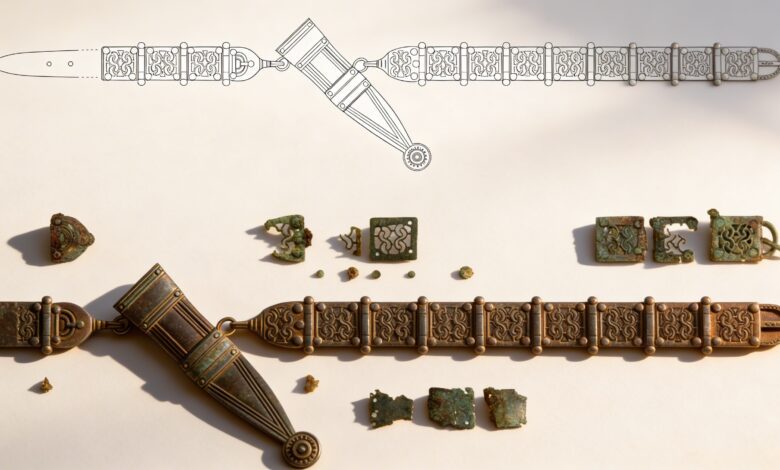
An unexpected discovery in the La Cerrosa-Lagaña cave in Asturias could reshape the understanding of Roman conquests in Spain. Archaeologists found a bronze belt there, which, as it turned out, was not made in Roman workshops but crafted by local Vaccean artisans. This item became a prototype for the famous cingulum—the belt later worn by Roman legionaries and auxiliary troops. The finding highlights how closely cultures intertwined in what is now Spain and how local traditions influenced Roman military practices.
The belt was found alongside other military objects and the remains of a man, believed to be a Roman soldier sacrificed during the Astur-Cantabrian wars. These events took place at the end of the first century BC, when Emperor Augustus was trying to subdue the northern tribes of the Iberian Peninsula. According to El Pais, the soldier was captured by the Cantabri and sacrificed in a ritual, with his equipment left in the cave as an offering to the gods.
Discovery details
The belt’s construction is particularly noteworthy: it is made of bronze plates joined together, making it more flexible and comfortable to wear. Analysis showed that the belt was crafted in the central part of the Iberian Peninsula, most likely by Vaccean artisans. The decorative elements—stylized animal figures—also point to a local origin. Researchers believe that such belts served as the basis for the later adoption of the cingulum in the Roman army.
Along with the belt, archaeologists discovered a dagger sheath, a fibula, a spear tip, and a razor. According to experts, all these items were part of a ritual offering. The condition of the finds suggests they were made in the second half of the 2nd century BC to the end of the 1st century BC. Metal analysis and the design of the items confirm their local origin and connection to the region’s military traditions.
Rituals and Sacrifices
Researchers believe that the items and remains found in the cave indicate ritual sacrifices. The Cantabrian tribes, who resisted the Romans, offered captured enemies and their weapons as sacrifices to gain the favor of the gods in their struggle against the empire. Such rituals were typical among many ancient peoples of Spain and are confirmed by finds from other caves in the region.
The La Serrosa-Lagaña belt became one of the earliest known prototypes of the Roman military belt, which was later adapted and mass-produced within the Roman military system. A similar process occurred with curved-blade daggers, which the Romans also adopted from local tribes and developed into the famous pugio.
Impact on History
The discovery in Asturias confirms that the Roman army actively adopted weaponry and equipment from conquered peoples. This not only increased the legionaries’ effectiveness but also helped integrate local traditions into the empire’s military culture. As El Pais notes, such finds are changing perceptions of Spain’s role in shaping Roman military power.
In recent years, archaeologists have been increasingly finding objects in northern Spain’s caves linked to rituals and military conflicts from the era of Roman conquests. These discoveries provide deeper insight into how local tribes and Romans interacted, and how these contacts influenced the development of weaponry and customs.
In other regions of Spain, artifacts have also been found attesting to ritual sacrifices and offerings in caves. For example, in Cantabria and Galicia, archaeologists have uncovered weapons and jewelry left in hard-to-reach places. These findings confirm that the tradition of using caves as sacred spaces endured for centuries and played a key role in the lives of local communities.