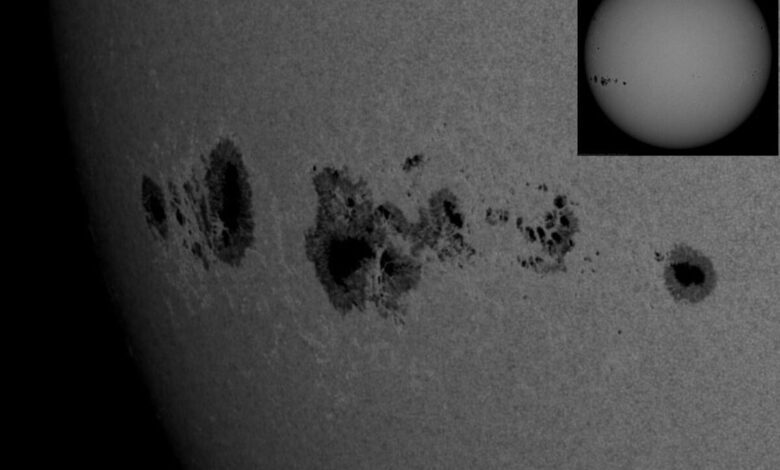
An unusually large sunspot group has appeared on the side of the Sun visible from Earth, drawing the attention of solar activity experts. The sheer size of this formation is remarkable: according to researchers, the sunspots cover around 60% of the maximum area recorded in the 21st century. Moreover, this current cluster is significantly larger than anything observed so far this year, including the record-setting group in May.
However, despite its impressive size, the group is behaving unexpectedly calmly. Over the past two days, there have been no significant flares or eruptions, which has puzzled astronomers. Typically, such massive sunspot clusters are accompanied by powerful energy releases, but right now, things remain unusually quiet.
Experts at the Space Research Institute of the Russian Academy of Sciences (IKI RAN) note that this behavior does not fit the usual patterns of sunspot development. According to them, the accumulated energy should have already produced flares, but that has not happened. The reasons behind this phenomenon remain unclear for now.
Possible scenarios
Among the proposed theories is the idea that the sunspot group is preparing for a major flare, one that could become historic in the realm of solar observations. Some scientists suggest that we might witness a rare event — a superflare capable of impacting near-Earth space and even disrupting satellite systems.
At the same time, there is a possibility that what is happening is linked to processes inside the solar plasma that have not yet been studied. It is possible that the energy is dissipating in a different way, without leading to the usual eruptions. Such anomalies highlight how little we really know about the mechanisms driving our star’s activity.
Response from the scientific community
Astronomers around the world are closely monitoring the situation as it unfolds. A discussion has already emerged in scientific circles about the possible consequences of such unusual sunspot behavior. Some experts are calling for increased monitoring to ensure that the moment when the accumulated energy is finally released does not go unnoticed.
In recent years, interest in solar activity has grown significantly, as powerful flares can affect electronics, radio communications, and even human health. That is why any deviations from the norm attract heightened attention and require careful analysis.
Historical context
Large sunspot groups have been observed before, but such a prolonged lull despite their enormous size is rare. In the past, similar formations were usually accompanied by a series of flares of varying intensity. Now, however, scientists are faced with a situation where the usual patterns do not apply.
This is forcing experts to rethink existing models and look for new explanations. The phenomenon being observed may offer a new perspective on the processes taking place deep inside the Sun, bringing science closer to solving its mysteries.
If you didn’t know, the Solar Astronomy Laboratory of the Space Research Institute of the Russian Academy of Sciences is Russia’s leading scientific center specializing in the study of processes taking place on the Sun and in near-Earth space. The laboratory’s team regularly publishes real-time data on solar activity, analyzes solar flares and geomagnetic storms, and develops forecasts for various sectors, including energy and communications. Thanks to their work, scientists and specialists around the world receive up-to-date information about the state of our star.