Spanish and Portuguese police dismantled a cross-border drug network on the Guadiana. Officers seized over 10 tons of hashish and arrested 10 suspects. The operation targeted key storage points used for trafficking across Europe.
Authorities in Spain and Portugal have dismantled a major drug trafficking network operating along the Guadiana River, a region long considered a strategic corridor for smuggling between the two countries. In a coordinated operation, the Guardia Civil and the Guarda Nacional Republicana (GNR) seized 10,600 kilograms of hashish, arrested 10 individuals, and confiscated nine vehicles and three firearms. The action marks one of the largest recent blows against organized crime in the southwest of the Iberian Peninsula.
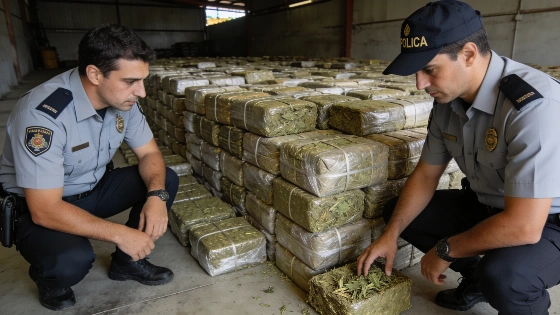
The investigation, codenamed Tridente, focused on dismantling the group’s logistics. Officers first moved in on a property in Ayamonte, Huelva, after extensive surveillance. Inside, they discovered a drug storage facility containing 132 bales of hashish weighing 5,280 kilos. Three suspects were detained at the scene. Police also recovered six vehicles—five of which had been stolen and modified for hidden transport—and two loaded firearms, a pistol and an assault rifle. The detainees were charged with drug trafficking, illegal possession of weapons, vehicle theft, and document forgery. A judge ordered their immediate pre-trial detention.
Two days later, the investigation led Spanish and Portuguese forces to a second property on the Portuguese side of the river, in an area known for cross-border criminal activity. There, officers found another 133 bales of hashish, totaling 5,320 kilos, along with three vehicles (at least one stolen) and a pistol. The suspects initially escaped by boat but were intercepted shortly after thanks to a joint deployment of land, sea, and air units. Seven more individuals were arrested and handed over to Portuguese judicial authorities, who also ordered their provisional imprisonment.
The Guadiana River has become a focal point in the fight against drug trafficking, especially after a fatal incident last October when a Portuguese officer died and three others were injured during a collision with a drug boat. The latest operation not only disrupted the group’s storage and distribution network but also highlighted the risks faced by law enforcement in the region. The dismantled organization had used the river to move large quantities of hashish for distribution in Spain, Portugal, and other European countries.
Cross-border cooperation has become increasingly important as criminal groups adapt their methods. The seizure of such a large quantity of hashish underscores the scale of trafficking through southern Spain and Portugal. According to official data, the region remains a primary entry point for hashish into Europe, with traffickers often using modified vehicles and river routes to evade detection. The success of this operation follows other high-profile cases, such as the recent rescue of a truck driver in Catalonia linked to a missing cocaine shipment, detailed in this report on a kidnapping tied to drug theft in Barcelona. The ongoing efforts by Spanish and Portuguese authorities reflect a broader strategy to disrupt organized crime networks and secure the border areas most vulnerable to trafficking.