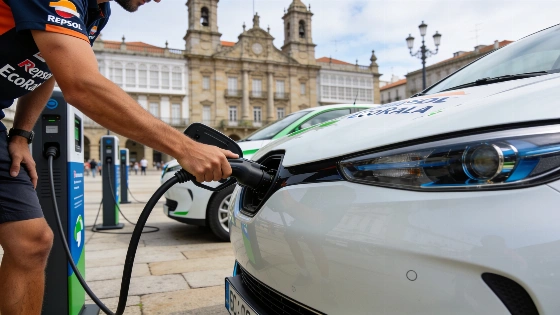
A Coruña turns into Spain’s electric car laboratory as the 10th Repsol EcoRallye brings 57 teams and 52 new charging points to the city. The event spotlights both the rapid gains and the stubborn roadblocks holding back EV adoption.
Fifty-two new charging stations now stand in María Pita square, but the real challenge in A Coruña isn’t just about hardware. Spain’s electric car revolution is racing ahead on paper, but can the reality keep up? The 10th Repsol EcoRallye A Coruña, part of the FIA EcoRally Cup, drew 57 teams and plenty of industry attention. Still, the city’s new chargers highlight a bigger problem: infrastructure and public trust are still lagging. City officials note this is the third year running that the rally is part of the FIA Eco Rally Cup calendar, marking a decade of growth and rising importance for the region.
Oliver Fernández, Repsol’s director of Electric Mobility for Spain and Portugal, doesn’t sugarcoat the problems. Spain claims about 53,000 public charging points, but many sit unused, stuck in paperwork or waiting for grid connections. “We can install a charger in 15 days, but it can take up to two years to actually switch it on,” Fernández told Quincemil. The delays aren’t just about forms—ultra-fast chargers face even more grid bottlenecks, slowing progress where it’s needed most. AEDIVE, Spain’s national electric mobility association, now only counts active charging points in its stats to show the real picture.
The official National Action Plan published on September 14, 2026, lists 42,318 public charging points in Spain with a total installed capacity of 2,269,170 kW—significantly lower than industry estimates.
Galicia used to lag behind, but it’s catching up fast. Repsol alone runs about 500 rapid and ultra-rapid chargers in the region, responding to a jump in electric and plug-in hybrid registrations. But Fernández warns that infrastructure has to keep pace with demand. Repsol’s multi-energy strategy means not every answer will be electric. “Not everything will be electric vehicles,” he says. Renewable fuels will still be needed for sectors where batteries don’t make sense. The rally’s 586 km route, highlighted in independent coverage, shows how much range and charging access matter for real-world EV use.
For drivers, price is still a sticking point. Fernández won’t guess when electric cars will match combustion models without subsidies. The industry needs huge investment to get there. “The public wants to move at a competitive price and without restrictions,” he says. The best solution depends on each customer’s needs and whether the technology can pay for itself.
Range anxiety and charging times still put off many would-be EV owners. Fernández questions the obsession with ultra-fast charging. Most cars spend hours parked at home or work, where slow, cheap charging is often enough. But for long trips—like Madrid to Galicia—ultra-rapid chargers are essential. Repsol’s network aims to cover both needs, but the company insists there’s no one-size-fits-all answer.
According to AEDIVE, as of September 1, 2026, Spain had 52,746 operational public charging points, a 5.49% increase over the previous year. However, independent reviews confirm that a notable share of these points may be unavailable due to connection or operational issues, highlighting the ongoing gap between installed and truly active infrastructure.
Looking ahead, Fernández won’t predict when electric cars will take over new sales. He points to aviation, where only sustainable fuels—not batteries—can cut emissions. The shift will be uneven, he says, and patience is needed as technology and infrastructure change in unpredictable ways.
For Repsol, public charging is a long-term bet. “This is not a 100-meter sprint,” Fernández says. The company is focused on national coverage and making charging easy. Now, 95% of its network—almost all rapid and ultra-rapid points—support Autocharge. Drivers just plug in and go after a one-time pairing with Waylet. No cards or apps needed. The goal: make charging simple and accessible, even as the industry’s future remains up in the air.
Spain’s charging network is growing, but real progress is still slowed by red tape and grid limits. The country just saw its first-ever drop in petrol stations, as reported earlier, showing a market in transition. But the electric shift is far from automatic. The EcoRallye in A Coruña isn’t a victory lap—it’s a stress test for the whole system.
This year’s rally paints a picture of progress mixed with persistent friction. Spain’s push for electric mobility is real, but the road ahead is anything but smooth. Industry leaders are right to call for patience and realism—without them, the promise of a fully electrified future could stall before it really begins.