British farmer Tim Scott buried two pairs of cotton long johns in different fields to test how soil treatment affects decomposition. After two months, the unploughed soil had almost completely digested one pair, while the other remained nearly intact. The result offers a striking look at the invisible life beneath our feet.
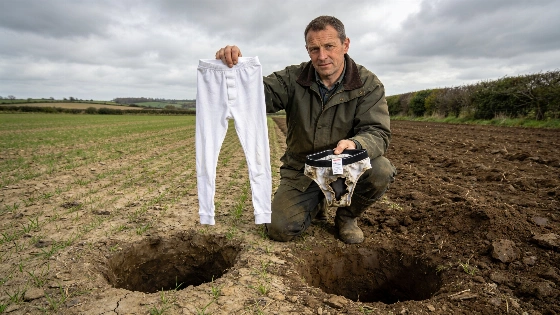
When Tim Scott dug up two pairs of cotton long johns from his fields in Barton, Cambridgeshire, the difference was impossible to miss. One pair, buried in unploughed soil, had been reduced to little more than an elastic waistband and a label. The other, placed in a recently ploughed strip, looked almost as good as new.
Scott, who manages land at Lark Rise farm, set up the experiment to see how soil management shapes the activity of microbes. He buried the first pair—decorated with a green tractor—in a field managed with direct drilling and no ploughing. The second, marked by a red tractor, went into a control strip that had been turned over with a plough after years of regenerative farming. Both pairs spent two months underground, though the exact dates were not specified.
On retrieval, the contrast was dramatic. The unploughed soil had almost entirely consumed the cotton, leaving only the waistband and tag. In the ploughed strip, the fabric was barely touched. Scott noted that, after a quick wash, the second pair could have been worn again. The experiment made visible what usually stays hidden: the intense microbial life in healthy, undisturbed soil.
Microbes at Work
Scott explained that direct drilling preserves the soil’s structure and the microscopic life within it. In the unploughed field, the microbes had enough stability and resources to break down nearly all the cotton. In contrast, ploughing disrupts the soil, reducing microbial populations and their ability to decompose organic matter. The result, Scott argued, is a clear sign of how farming practices can either support or undermine the living ecosystem beneath crops.
What the Test Shows—and What It Doesn’t
The experiment was simple: two identical garments, buried for the same period, in two differently managed plots. The outcome was clear, but the test did not include laboratory analysis, moisture measurements, or multiple repetitions. As such, it serves as a vivid demonstration rather than scientific proof that all unploughed soils will decompose cotton at the same rate. Its value lies in making the invisible visible, not in offering universal conclusions.
Soil Health and Broader Implications
Microbial activity in soil is crucial for breaking down organic matter, cycling nutrients, and supporting healthy plant growth. According to Scott, biologically active soils are also less prone to erosion, filter water more efficiently, and store more carbon. These benefits align with the philosophy of the Countryside Regeneration Trust, which owns Lark Rise and focuses on restoring land and wildlife while supporting rural economies.
Scott’s experiment echoes a broader trend in European agriculture, where regenerative practices are gaining ground. For example, the rapid expansion of pistachio farming in Castilla-La Mancha, as described in this report on Spain’s pistachio boom, highlights how changing land management can reshape both productivity and the environment.
While Scott’s buried underpants may seem like a quirky test, the message is serious: the way we treat soil has consequences that reach far beyond the surface. The experiment offers a rare, tangible glimpse into the hidden world that sustains our food and landscapes.