Aena has ruled out converting Casarrubios del Monte into Madrid’s second commercial airport, citing airspace and operational issues. Instead, the airport operator will invest over €4 billion to expand Barajas, aiming for a capacity of 90 million passengers a year.
Aena has officially dismissed the proposal to transform Casarrubios del Monte into a second commercial airport for Madrid, citing significant operational and airspace compatibility concerns. The decision, presented by executive vice president Javier Marín during a July 2026 analyst conference, comes as the company unveils plans to boost Adolfo Suárez Madrid-Barajas Airport’s capacity to 90 million passengers annually.
According to Marín, the location of Casarrubios presents complex challenges. The area is already crowded with air traffic from Barajas, Cuatro Vientos, and other nearby aerodromes. Integrating a new commercial airport would require intricate coordination of flight paths, approaches, and departures, risking disruption to existing operations. The proximity to Cuatro Vientos is particularly problematic, as its southwest departures intersect with the Casarrubios airspace, just 25 kilometers away. Any changes would necessitate a complete overhaul of flight procedures, with the added difficulty of avoiding urban areas.
Private Project Scaled Back
The private consortium Air City Madrid Sur has already reduced the scale of its original 2018 proposal, aiming to avoid classification as an airport of general interest. The revised plan includes extending the current runway to 1,800 meters, building a new 3,200-meter runway, and constructing a terminal for up to one million passengers per year. The project still requires an estimated €400 million investment and remains under review by the Interministerial Defense-Transport Commission.
Despite the downsizing, the project faces a critical hurdle: it must secure public use status, certification from Spain’s aviation authority (AESA), a master plan, environmental permits, and urban planning licenses. Most importantly, it needs to prove airspace compatibility—a requirement that Aena’s technical objections now cast into serious doubt. While Aena’s stance is not an outright administrative rejection, it introduces a major technical barrier that could force a fundamental rethink of the project.
Barajas Expansion Takes Priority
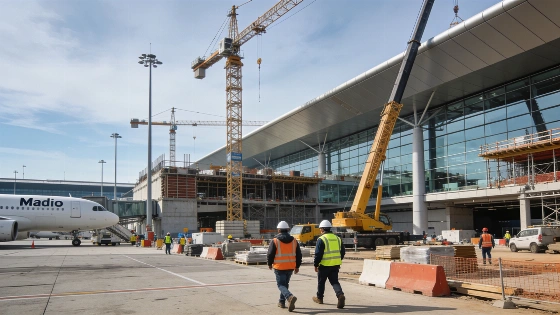
Instead of supporting a second airport, Aena is doubling down on expanding Barajas. Marín emphasized that Barajas, with its four runways, can theoretically handle up to 120 operations per hour. The real bottleneck, he argued, lies in terminal processing capacity. As a result, Aena’s strategy centers on enlarging terminals T4 and T4S, adding new aircraft stands, and modernizing facilities. The expansion plan, with a budget exceeding €4 billion, aims to accommodate up to 90 million passengers annually.
On July 30, Aena approved contracts worth €146.47 million for the T4 North Platform and T4S South Pier, both part of the DORA III investment program for 2027–2031. In the first half of 2026, Barajas handled 34.06 million passengers, up 4.2% year-on-year, with June alone seeing over 6 million travelers and nearly 39,000 aircraft movements.
Debate Over Future Demand
Backers of the Casarrubios project argue that Madrid’s air traffic growth will eventually outpace even an expanded Barajas, especially as demand for point-to-point flights, low-cost carriers, cargo, and executive aviation rises. They also note that smaller aircraft could require more frequent movements to carry the same number of passengers. Aena, however, maintains that the current runway system and planned terminal upgrades will be sufficient for the foreseeable future, including during peak hours.
The fate of Madrid Sur now hinges on further technical assessments and government approvals, particularly regarding airspace compatibility. While the private project remains under review, Aena has already begun work on the Barajas expansion, with construction underway at T4 and T4S to reach the new capacity target. Marín’s remarks came during the company’s first-half results presentation, underscoring Aena’s commitment to consolidating Madrid’s air traffic at Barajas rather than dividing it between two airports.