The Andalusian Antifraud Office is investigating Álvaro Zancajo for possible incompatibility between his Vox party role and his paid seat on RTVA's board. The case raises questions about exclusivity rules and political influence in public media.
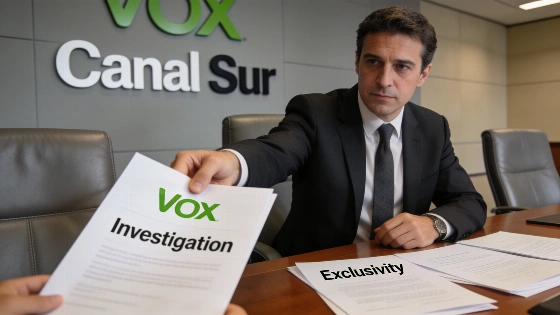
The Andalusian Office Against Fraud and Corruption (OAAF) has launched an official investigation into Álvaro Zancajo, the national communications coordinator for Vox, over potential incompatibility between his party duties and his position as a board member at RTVA, the region's public broadcaster. The probe follows a formal complaint from Adelante Andalucía, which alleges that Zancajo's dual roles breach RTVA's strict exclusivity requirements for board members—a post that comes with a €60,000 annual salary.
According to the complaint, Zancajo has been serving as Vox's chief press officer while simultaneously holding the only board seat allocated to the party at RTVA. The broadcaster's internal regulations demand “absolute and exclusive dedication” from its board members, explicitly prohibiting any other public or private professional activity, including teaching or holding elected office in bodies with public functions. Adelante Andalucía argues that Zancajo's ongoing work for Vox, particularly in media relations and public communications, directly conflicts with these rules and could undermine the broadcaster's independence.
Adelante Andalucía's spokesperson, José Ignacio García, has publicly criticized the situation, stating that Zancajo does not devote time to RTVA board duties and instead focuses on his responsibilities within Vox. The OAAF's decision to open an investigation was confirmed by García, who has highlighted the broader issue of political appointments and influence within Canal Sur, the main channel operated by RTVA. He also recalled that Vox initially entered Andalusian politics in 2018 with calls to shut down RTVA, but now seeks greater presence and influence within the broadcaster.
Zancajo's appointment to the RTVA board dates back to 2022, following his earlier tenure as director of Informativos de Canal Sur in 2020. His selection was made by Vox, which holds one of the nine seats on the board, alongside five for the PP and three for the PSOE. In October 2024, Vox leader Santiago Abascal created the role of national media coordinator, naming Zancajo to the post. This dual responsibility has drawn criticism from RTVA staff and unions, who were among the first to question the compatibility of his roles and to call for his removal from the public broadcaster. Concerns over impartiality and neutrality in Canal Sur's news coverage also contributed to Zancajo's earlier dismissal as news director.
The controversy around Zancajo is not isolated. Similar cases of public officials facing scrutiny over potential conflicts of interest have emerged in Spain in recent years. For example, the government previously declined to dismiss the Guardia Civil chief amid an internal investigation, as reported in a related case involving the Guardia Civil director. These incidents highlight ongoing debates about transparency, accountability, and the boundaries between political activity and public service in Spain's institutions.
RTVA's exclusivity clause is designed to safeguard the broadcaster's independence and prevent undue political or commercial influence. The outcome of the OAAF investigation could set a precedent for how such rules are enforced in Andalusia and potentially influence similar cases across Spain. The case also underscores the persistent tension between political parties seeking influence in public media and the need to maintain editorial autonomy. As the investigation proceeds, attention will remain focused on whether Zancajo's dual roles are deemed incompatible and what consequences, if any, will follow for both him and Vox's standing within RTVA.
For context, RTVA (Radio y Televisión de Andalucía) is the main public broadcasting entity in Andalusia, operating television and radio services including Canal Sur. Board members are appointed by political parties in proportion to their representation in the regional parliament, a system that has often led to debates about political influence over public media. The OAAF, established to combat corruption and promote transparency in Andalusia, has the authority to investigate potential breaches of public sector regulations and recommend sanctions or corrective measures. The current case involving Zancajo is being closely watched by media professionals, political observers, and the public, as it may influence future standards for public service appointments and the separation of political and media roles in Spain.