Anne Carson turns translation into a literary act. Her Nobel recognition follows books where damaged texts, modern lives and classical forms occupy the same page.
The Swedish Academy awarded Anne Carson the 2026 Nobel Prize in Literature for an audacious and inventive body of work that, in playful dialogue with the classical tradition, creates new forms of contemporary literature.
That wording places translation inside the act of creation. Carson’s books bring ancient Greece into the present, then make poetry press against theatre and scholarship against personal memory. The award gives that method its clearest public recognition.
The academy used three adjectives to describe the work: audacious, inventive and playful. Each points to a different way Carson unsettles the usual boundaries of literature. The Nobel Committee also treats her philological attention and translation practice as tools for literary invention, rather than as support work around an original text.
Carson’s interest in ancient Greek began at school, when her Latin teacher taught her Greek during lunch breaks. In 1981, she received a doctorate in Classics from the University of Toronto.
Her audacity comes through in the collisions. Genres, languages, historical periods and characters cross into one another instead of staying in separate compartments. Autobiografía de Rojo is a novel written in verse. Las mujeres troyanas turns Greek tragedy into a comic book in collaboration with Rosana Bruno.
A fifth-century BCE tragedy contains a motorboat in Antigo Nick. In H de H Playbook, another character lives in a trailer park. Norma Jeane Baker de Troya makes Helen of Troy and Marilyn Monroe one protagonist, connecting ancient objectification of women with its modern forms while keeping the distance between the eras intact.
Carson translates more than words.
The Nobel Committee treats Carson’s translations of Sappho, Sophocles and Euripides as literary works in their own right, not as secondary versions of Greek originals. Her projects include Sappho’s fragments in <em>If Not, Winter</em> and translations of <em>Electra</em>, <em>Antigone</em> and <em>The Bacchae</em>.
Her books are translations and new creations at once. They carry readers toward ancient Greece while bringing mythological figures into a recognisably modern world. The effect comes from the pressure between two realities occupying the same page, rather than from one reality replacing the other.
Her inventiveness begins with discovery. The Latin verb invenio means “to discover”, and Carson gives that meaning practical force. In classical texts, she finds grief, desire and vulnerability that remain legible thousands of years later. The Swedish Academy has described the method as a meeting between close attention to words and a poetic drive toward new meanings.
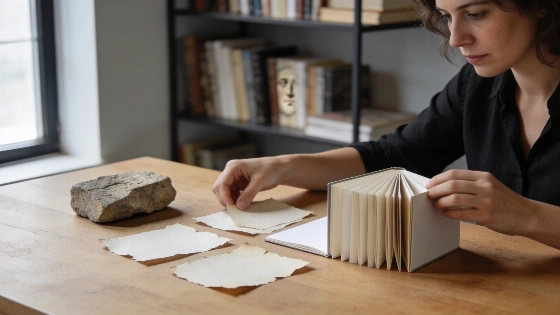
After the death of her brother, Carson translated a Latin poem about the loss of a sibling. The work became Nox, an accordion-shaped book containing family letters, photographs, drawings and anecdotes. Translation moved beyond the original language because mourning could not fit inside a verbal equivalent.
Nox changes the reader’s task. Emotion is rebuilt through images, objects and the physical form of the book. A translation can be felt as well as understood.
Carson’s playfulness is material too. In Si no, el invierno, her translation of Sappho, square brackets mark gaps left by damaged papyri. Fragments such as “]corazón]” and “]absolutamente]” preserve the missing spaces instead of concealing them.
Those marks turn the text’s history into part of the reading experience. Poems more than two thousand years old survived on fragile materials and only in fragments. The reader works through the gaps while remaining aware that the original cannot be fully recovered.
This is translation as contact. Carson’s games make reading physical. The page records silence, damage and distance, while the book asks the body to participate in interpretation.
Spanish readers encounter another layer through the work of Tedi López Mills, Jordi Doce and Jeannette L. Clariond. Bringing Carson into Spanish requires decisions about her classical learning and her reinvention of English through the languages she translates. It also demands choices about hybridity, silence, intimacy and strangeness.
That second movement extends Carson’s work. Her Spanish translators create another wave from the same stone thrown into the water, carrying her forms and tensions into a different language and cultural memory.
The Nobel recognition matters here because Carson’s writing carries readers across time and culture without pretending that difference has vanished. It preserves what can be understood and gives shape to what remains broken or unfamiliar. Nobel Committee chair Anders Olsson said Carson moved beyond lyric poetry confined to a narrative “I”, helping to inspire new forms of contemporary literature.
Carson is the third writer born in Canada to receive the Nobel Prize in Literature, after Saul Bellow in 1976 and Alice Munro in 2013. The prize carries 12 million Swedish kronor, approximately 1.2 million dollars, and is scheduled to be presented in Stockholm on 10 December.