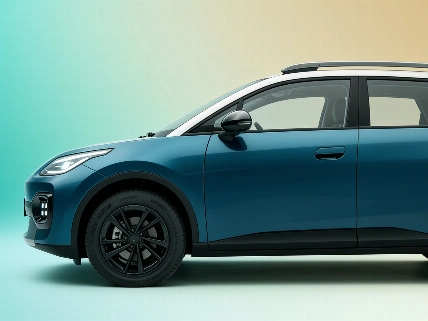
Audi is set to launch the A2 e-tron, a compact electric car focused on efficiency, range, and affordability. Early tests highlight its new LFP battery, aerodynamic design, and real-world performance ahead of its official debut.
The Audi A2 e-tron is nearing its official launch, and the final pre-production model already signals a shift in how compact electric cars are engineered. With its debut scheduled for the end of summer, the A2 e-tron stands out for its focus on efficiency, innovative battery technology, and aerodynamic precision.
Unlike the imposing Audi Q9, the A2 e-tron is designed as a practical, forward-thinking alternative. Audi’s development team has prioritized a streamlined body and energy-saving features, aiming to address the main concerns of electric vehicle buyers: range and charging speed. The result is a compact model with an impressive drag coefficient of 0.24, a newly developed LFP battery, and a powertrain optimized for real-world use.
New LFP Battery Technology
Central to the A2 e-tron’s appeal is its 61 kWh LFP (lithium iron phosphate) battery. According to Audi’s product manager, this battery is not only more affordable but also more sustainable, as it avoids the use of cobalt and nickel. Benedikt Hackl, responsible for the car’s electrical systems, notes that the LFP chemistry offers greater long-term stability and slower degradation, even when charged to 100% regularly.
While Audi has not disclosed the full technical details, the battery supports a maximum charging rate of 105 kW at fast chargers, allowing a 10% to 80% top-up in just 26 minutes. This positions the A2 e-tron as a practical option for daily use and longer journeys alike.
Aerodynamics and Real-World Efficiency
Audi’s engineers have gone to great lengths to minimize air resistance, knowing that aerodynamic drag is the main enemy of electric range. At typical highway speeds, air resistance can account for up to 67% of energy consumption. During a test drive between Copenhagen and Skillinge, the A2 e-tron achieved an average speed of 65 km/h in real traffic, with air conditioning running. In these conditions, aerodynamic drag made up 47% of total energy use, while rolling resistance and internal losses accounted for most of the rest.
The car’s bodywork borrows cues from the original A2, especially at the rear, but introduces new solutions like rounded edges, active cooling borrowed from the Volkswagen ID.7, and wheel arch deflectors to reduce turbulence. The wheels themselves feature a closed, aerodynamic design, and the underbody is fully covered, taking advantage of the flat battery pack. A subtle spoiler on the C-pillar further directs airflow, working in tandem with the rear wing.
These efforts translate into real-world efficiency. On Swedish roads, the A2 e-tron recorded consumption as low as 11.5 kWh/100 km, suggesting a realistic range of around 450 km per charge. This figure is competitive, especially when compared to other electric SUVs that have recently set benchmarks in range, such as those highlighted in recent endurance tests of the Tesla Model Y.
Powertrain and Driving Experience
The A2 e-tron is built on the MEB+ platform, sharing its architecture with the Volkswagen ID family and the updated Audi Q4. It uses the APP350 motor, which is 10% more efficient than previous versions and features an integrated transmission with reduced friction and lower-viscosity oil. These refinements add up to an extra 12 km of range on a full charge.
Behind the wheel, the A2 e-tron feels remarkably refined for a pre-production car. Despite the camouflaged exterior and covered interior, the driving experience is smooth and quiet, with a natural steering feel and brake response that sets it apart from many electric rivals. Suspension tuning is on the firmer side, but this is unlikely to be a drawback in everyday use.
What Sets the A2 e-tron Apart
Early tests indicate that the A2 e-tron can achieve real-world consumption as low as 11.2 kWh/100 km, pointing to a potential range above 500 km—an impressive figure for a compact EV. Audi has also confirmed that higher-capacity batteries will be available, but the 61 kWh LFP version is expected to be the most accessible in terms of price and sustainability.
As the electric vehicle market grows more competitive, the A2 e-tron’s combination of efficiency, affordability, and thoughtful engineering could make it a standout choice for drivers seeking a practical, future-ready car. The model’s focus on real-world usability, rather than just headline figures, reflects a broader shift in how automakers are approaching the next generation of electric vehicles.
For context, LFP batteries are gaining traction across the industry for their cost and durability advantages, while aerodynamic improvements are becoming a key differentiator in EV design. The A2 e-tron’s approach suggests that the next wave of electric cars will be defined as much by engineering detail as by raw performance or luxury.