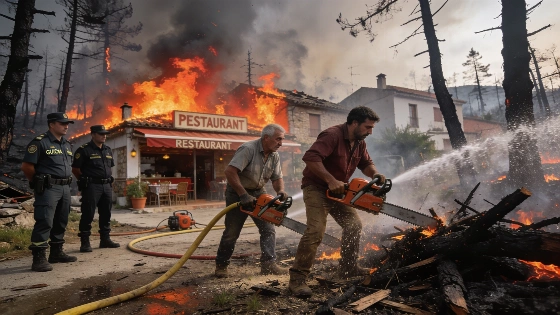
A devastating wildfire in Ávila has destroyed homes, businesses, and livelihoods. Local families, including the Gómez, fought to protect their property amid limited resources and police intervention. The crisis exposes gaps in emergency response.
In Ávila’s Valle de Iruelas, a fast-moving wildfire has left entire communities scrambling to save what remains of their homes and businesses. The Gómez family, well-known local restaurateurs, found themselves at the center of the crisis as flames swept through the area, destroying nearly everything in their path. With only two tents surviving in a once-busy campsite, the devastation is clear: melted bungalows, charred vehicles, and the acrid smell of burnt plastic now dominate the landscape.
As the fire advanced, the Gómez family and their neighbors took desperate measures to protect their livelihoods. Lacking sufficient official support, they cut down trees to create firebreaks near their restaurant—a move that nearly led to their detention by the Guardia Civil. According to the family, officers threatened arrest for their actions, highlighting the tension between local survival instincts and official protocols. Despite the risk, the family persisted, determined to prevent the flames from reaching their business.
Erick Gómez, who has previous experience with forest brigades, described how he ferried trapped residents and even two Guardia Civil officers to safety by boat as the fire closed in on the village of Rinconada. The urgency was palpable, with horses wading into the water to escape the heat and residents working through the night to clear fallen trees and keep evacuation routes open. The family’s efforts were mirrored by other locals, who joined forces to battle the fire with whatever tools they had.
Frustration grew as residents noted the lack of immediate aerial support, despite the proximity of a reservoir. Many felt abandoned during the critical early hours, with some criticizing the response of the Unidad Militar de Emergencias. The sense of isolation was compounded by the destruction of homes—some left uninhabitable, others reduced to ruins. The Gómez family, exhausted and covered in cuts from their efforts, continued to help neighbors clear debris and check on damaged properties.
For Jesús Gómez, the patriarch, this wildfire is the latest in a series of personal disasters. He recounted previous fires that destroyed his painting business in Madrid and a restaurant, both times receiving no insurance compensation. Now, as he travels to El Barraco—another town hit by the flames—he reflects on the narrow escape of his partner’s hostel and the bar where he works, both of which survived the latest disaster. Calls from concerned friends and family punctuate his journey, each seeking news about their own properties.
At the hostel El Encuentro, María José Hernández, Jesús’s wife, described the ordeal as overwhelming. She expressed pride in her family’s commitment to their community but lamented the slow arrival of emergency resources. The fire, she warned, threatens not just property but the future of families who depend on the region’s natural beauty for their livelihoods. The fear is that, without visitors, the local economy will struggle to recover.
As the situation evolved, a new column of smoke appeared near the reservoir, prompting another rush to defend scattered homes. Residents and firefighters from various regions worked side by side, laying hoses and using beaters to contain the flames. Relief finally came as helicopters dropped water, briefly lifting spirits amid the ongoing crisis.
This wildfire in Ávila is part of a broader pattern of severe fires affecting central Spain in recent years. Similar emergencies have forced evacuations and disrupted daily life, as seen in recent incidents impacting both Madrid and Ávila. The recurring nature of these disasters underscores the vulnerability of rural communities and the urgent need for coordinated emergency response and prevention strategies.
Wildfires have become a persistent threat in Spain, particularly during periods of extreme heat and drought. The country’s rural areas, often characterized by dense forests and limited infrastructure, face unique challenges in fire prevention and response. The experience of the Gómez family and their neighbors highlights the resilience of local communities but also exposes gaps in official support and the complexities of balancing safety regulations with urgent action during emergencies.