In Ukraine’s Donbas, birds have begun weaving abandoned fiber optic cables from military drones into their nests. This adaptation highlights how modern warfare is leaving a lasting mark on local ecosystems and complicating future land recovery.
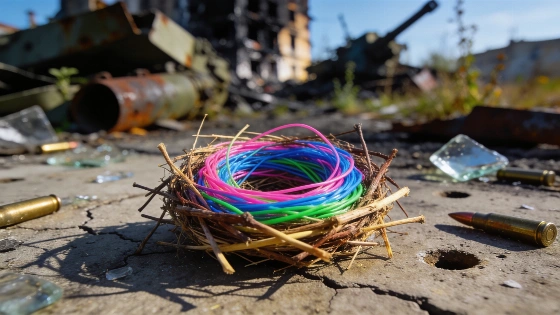
When Ukrainian soldiers discovered a bird’s nest in the war-torn Donbas region, they found it woven not just from twigs and grass, but from the thin, gleaming strands of fiber optic cable left behind by military drones. The image, shared by activist Olena Tregub and documented by Oleh Malchenko, offers a stark glimpse into how the ongoing conflict is altering the natural world in unexpected ways.
According to The Jerusalem Post, the nest was found after a Russian glide bomb felled a tree, exposing the unusual construction. This is not an isolated case. As reported by Reuters on June 30, 2026, Ukrainian troops have encountered similar nests near the front lines, where fiber optic cables are now a common sight tangled in trees, scattered across fields, rooftops, and trenches.
Wartime Materials in Nature
For birds, these synthetic fibers are simply another resource in a landscape transformed by war. Fiber optic cables are lightweight, flexible, and durable—qualities that make them attractive for nest building. Unlike natural materials, however, these cables originate from military drones that use physical connections to avoid electronic jamming. The Conflict and Environment Observatory notes that some drones deploy spools of cable stretching five to twenty kilometers, with certain models reportedly reaching up to 41 kilometers. In active combat zones, these cables are rarely retrieved, often left damaged by explosions or fire.
Researchers at Kyiv’s War Museum are now studying these nests to identify which bird species are adapting to the new materials. The cables themselves can extend along much of Ukraine’s 1,200-kilometer front, creating a persistent presence in the landscape.
Environmental Hazards
The environmental impact of this phenomenon is significant. A 2025 analysis by Leon Moreland of CEOBS, published by the British Ornithologists’ Union, warns that abandoned fiber optic cables pose a serious entanglement risk for birds, bats, and terrestrial mammals. The situation is reminiscent of the dangers posed by discarded fishing nets in the ocean: animals can become trapped, injured, or unable to feed properly. In Ukraine, the risk is heightened by cables hanging from trees, stretching across clearings, or lying in open fields and roads.
The composition of these cables adds another layer of concern. Most are made from polymeric fiber optics, with a core of polymethyl methacrylate and fluoropolymer coatings. As they degrade, they can release microplastics that persist in the environment for centuries—CEOBS estimates up to 600 years.
Long-Term Consequences
The problem extends beyond wildlife. Abandoned fiber optic cables can hinder the restoration of farmland, forests, and areas awaiting demining after the war. CEOBS points out that these cables can become entangled in vehicles, disrupt machinery, and complicate future cleanup efforts. The widespread use of cable-guided drones—favored for their resistance to electronic countermeasures—means that each mission leaves behind more debris, embedding the technology of war into the landscape itself.
Birds incorporating these synthetic fibers into their nests are adapting to what is available, but the materials they use are designed to endure, not to break down. As Ukraine looks toward eventual recovery, the environmental legacy of modern warfare is likely to remain a challenge for years to come.