A wildfire devastated much of a Madrid reserve, but areas grazed by bison and cattle remained untouched. The animals’ presence helped preserve green ground cover and protected livestock, highlighting the role of managed grazing in wildfire prevention.
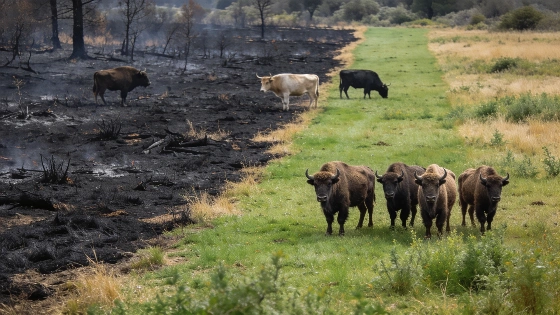
When flames tore through a private reserve between Colmenar del Arroyo and Robledo de Chavela, 160 out of 240 hectares were left charred. Yet, in a striking contrast, the sections grazed by European bison and cattle stayed green and unburned, offering a rare glimpse of how animal husbandry can shape the landscape’s resilience to fire.
The wildfire, which forced evacuations in Robledo de Chavela and Colmenar del Arroyo, was part of a larger emergency that affected around 28,000 hectares across Madrid’s Sierra Oeste. More than 55,000 residents were evacuated or confined as authorities scrambled to contain the blaze.
Bisonte Park, the reserve at the heart of the story, began reintroducing European bison in June 2025. Owners Raúl Rodríguez and Víctor Manuel Alonso launched the project with eight animals—six females and two males—restoring a species absent from the region for nearly 10,000 years. Their goal: to use natural grazing to manage vegetation and reduce fire risk.
Ten Minutes to Escape
The most dangerous moment came late Friday afternoon. As smoke thickened and evacuation orders spread, Raúl Rodríguez tried to move his horses and mares to safety. A blocked road prevented the arrival of a transport truck, so he left water at several points and opened gates to give the animals a chance to flee if needed. Soon after, with escape routes to both Colmenar del Arroyo and Robledo de Chavela cut off, Rodríguez, his father, and a neighbor named Javier navigated nearly impassable back roads, the fire just 40 meters away. Their escape took ten tense minutes, with the threat of being trapped by advancing flames ever-present.
Grazing as a Firebreak
At dawn, Rodríguez returned with his father, business partner, and the reserve’s veterinarian. They found the horses alive, suffering only minor scrapes. The cattle had grazed their pasture down to the soil, leaving a strip of sparse vegetation that acted as a natural firebreak. The same effect was visible in the bison enclosure, where the animals’ habitual paths remained green and untouched, sharply contrasting with the scorched surroundings.
This outcome echoes other Spanish experiments with livestock for wildfire prevention. In places like Soto del Real, herds of goats are used to clear dry brush near homes, while in Santiago-Pontones, 70,000 sheep help maintain thousands of hectares of public land. The principle is simple: managed grazing reduces fuel for wildfires, creating living barriers that slow or stop the spread of flames.
Rodríguez documented the aftermath in a video, highlighting the stark difference between untouched, grazed land and areas where intervention was restricted. “Where nothing is allowed, everything burned. Where the best firefighters in Spain—the bison—work, a natural firebreak appeared,” he remarked.
Limits and Unanswered Questions
While the visual evidence is compelling, there is no technical report yet to quantify exactly how much of the protection was due to grazing versus other factors like wind, terrain, or the fire’s path. Still, the contrast on the ground is hard to ignore.
After confirming all animals were safe, Rodríguez criticized the bureaucratic hurdles that, in his view, slow down essential land management. He said he had spent months seeking permission to clear brush and undergrowth near the stream and in overgrown areas. He also questioned restrictions on cutting trees, removing deadwood, or conducting controlled burns, calling for more practical, flexible rules.
Similar debates are underway elsewhere in Spain. In El Recuenco, Guadalajara, a project using nine European bison to manage 400 hectares of public land has sparked scientific discussion about the ecological role of these large herbivores. The effectiveness of such initiatives remains under study, but the events at Bisonte Park add weight to the argument for integrating livestock into fire prevention strategies.
Spain’s evolving approach to land management is also visible in the agricultural sector, where the rapid expansion of pistachio plantations in Castilla-La Mancha—now covering nearly 70,000 hectares—demonstrates how new practices can reshape rural economies and landscapes, as seen in this report on the region’s pistachio boom.
For now, the survival of Bisonte Park’s animals and the green corridors left by their grazing offer a practical example of how traditional methods, adapted to modern challenges, may help protect Spain’s countryside from the growing threat of wildfires.