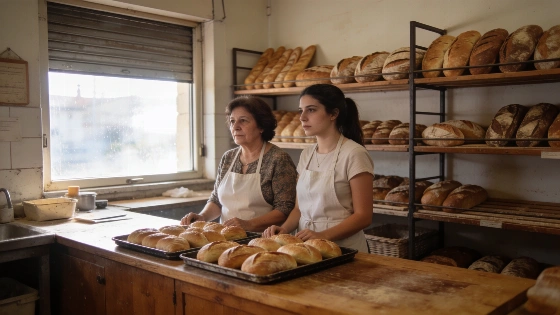
Villímar, a family-run bakery in Burgos with 72 years of history, has stopped opening on Sundays after struggling to hire staff for its early morning shift. Despite offering €1,600 per month and a reduced workweek, the owners could not fill the position.
At Villímar, a bakery with deep roots in Burgos, the doors now remain closed every Sunday—a decision driven not by falling demand, but by the inability to recruit staff willing to work the demanding early morning shift. The owners, Marimar de Miguel and her daughter Carla, had offered €1,600 per month across 15 payments and a 35-hour workweek, hoping to attract candidates for the 3:00 to 10:00 a.m. schedule. Yet, even with these terms, the position remained unfilled.
The vacancy required starting work before dawn, five days a week, with two days off. While the official schedule was 40 hours, the actual workload was reduced to 35 hours to offset the difficulty of the hours. The annual salary, spread over 15 payments, amounted to €24,000, though it was not specified whether this figure was gross or net. The offer did not detail the contract type or whether night work bonuses applied, and after several unsuccessful hires, the search was abandoned.
For Marimar and Carla, the challenge was not just about finding someone to fill a shift. The bakery’s production relies on skilled hands for kneading, fermentation, and precise baking—tasks that require both technical training and the ability to adapt to a schedule that starts long before sunrise. Each step in the process is tightly linked, and any absence can disrupt the entire day’s output.
Restructuring to Survive
Faced with repeated turnover and no lasting solution, the owners made the decision to close on Sundays, allowing the team to rest and removing the need to cover the most difficult shift. According to the owners, regular customers accepted the change, and the bakery continues to operate as usual during the other six days. The move has helped stabilize the business and reduce pressure on the remaining staff, ensuring the continuity of a family tradition that spans more than seven decades.
Broader Labour Challenges
The situation at Villímar is not unique. Across Spain, many manual trades are struggling to attract new workers, especially for roles that require specialized skills and unsociable hours. The bakery’s experience echoes similar difficulties in other sectors, such as construction, where companies face shortages of young recruits. As a result, some businesses are forced to reduce hours, limit production, or turn down certain shifts to protect their core operations.
While the bakery’s story highlights the specific challenges of night work and generational turnover, it does not support sweeping claims that “nobody wants to work.” Instead, it points to the complex reality of recruiting for demanding roles, even when pay and conditions are above average for the sector. The owners’ decision to close on Sundays was a pragmatic response to a persistent staffing problem, not a sign of business decline.
Context and Outlook
Spain’s labour market continues to evolve, with many traditional businesses adapting to changing expectations around work-life balance and shift patterns. As noted in a related report on retail sector adjustments, such as delays in implementing new deposit schemes at major supermarkets, companies across different industries are rethinking how to remain viable amid shifting workforce dynamics. For Villímar, closing one day a week has become the compromise that keeps the ovens burning for the rest of the week.