A CAF Class 557 train has traveled 273 kilometers using only its onboard batteries, with no diesel or external power. The test in Germany marks a step forward for battery trains, but also shows the practical limits of current technology.
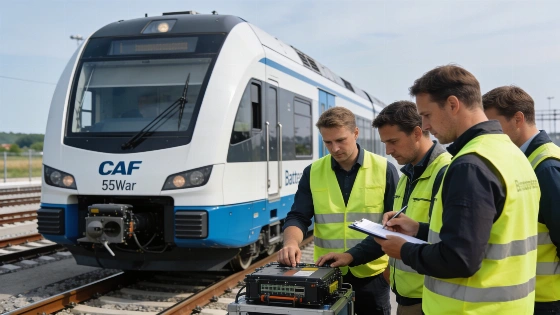
A CAF Class 557 train has completed a 273-kilometer journey powered entirely by its onboard batteries, without using diesel or overhead wires. The test, held at the Siemens Test and Validation Center in Wildenrath, Germany, puts the Spanish manufacturer in the spotlight as Europe looks for ways to cut diesel use on regional rail lines.
The train used for the test was a production-series Class 557 fitted with LTO batteries. CAF engineers ran the train through a full circuit with no external power, collecting data on energy use, traction, and battery performance under controlled but demanding conditions. According to CAF and industry reports, this was a serial-production train, not a prototype, and the results will help shape future battery train projects.
CAF has officially announced that the Class 557 BEMU will be showcased at InnoTrans 2026 in Berlin, with the exhibition scheduled for September 22–25, 2026.
The Class 557 comes from CAF’s Civity platform and is intended for the Verkehrsverbund Rhein-Ruhr (VRR) regional network. The company plans to show the same model at InnoTrans 2026 in Berlin, hoping to convince operators that battery trains are a practical option for lines without electrification. The test data will be used to improve energy management for future deployments.
The 273-kilometer figure, though, needs context. CAF notes that this number is not a guarantee for daily service. The test was run on a controlled track, and the company has not shared details like average speed, starting charge, or how much battery was left at the end. In real operation, factors such as hills, stops, passenger numbers, and heating or cooling can all reduce range. Operators will also need to allow for delays, detours, and weather. Industry reviews point out that the VRR’s longest required battery-only segment is about 220 kilometers, so CAF’s result is well above that, though the project has faced delays and passenger service is now expected later than first planned.
Battery trains like the Class 557 are meant for routes where full electrification is too expensive or complicated. They charge from overhead wires where available, then switch to battery mode for stretches without them. This allows for zero local emissions on lines that would otherwise use diesel, but it also means new challenges for charging infrastructure and scheduling.
The 273 km result was achieved under controlled test conditions at Siemens' Wildenrath facility, and does not guarantee the same range in daily service, where gradients, stops, passenger load, and climate can significantly affect battery autonomy. Industry observers note that the key question is how such test results will translate to real-world operations, especially during winter or on more demanding routes.
Battery trains are different from hydrogen trains, which generate electricity onboard using fuel cells. Each technology has its own requirements for infrastructure, maintenance, and cost. The choice between battery and hydrogen depends on route length, service frequency, and how easy it is to recharge or refuel. These questions are now under review as European rail operators and regulators consider their options.
CAF’s test is one of several recent technical milestones as the rail sector moves to phase out diesel. The data will help validate simulation models and guide future designs, but the Wildenrath result does not mean every route or condition is covered. As with the EU’s ongoing debates over electronic speed limits for motorcycles—reported earlier—the details of daily operation matter more than headline numbers.
For now, CAF has shown that a production train can run a significant distance on batteries alone. The real test will come when these trains enter regular service and face the unpredictable realities of regional rail. Until then, the 273-kilometer run is a technical milestone, but also a reminder that progress depends on real-world data, not just test results. The next steps will show whether battery trains can meet the demands of daily operation, or if their limits will require new solutions for Europe’s push to cut rail emissions.