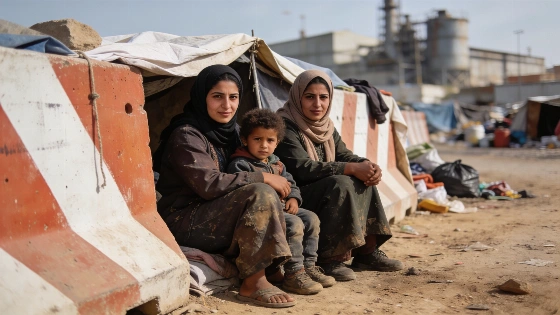
Ceuta’s hospitals are no longer overwhelmed, but hundreds of migrants remain in precarious camps. Authorities struggle to provide basic care and shelter. Tensions rise as local residents oppose new facilities.
Ceuta is grappling with a deepening humanitarian crisis weeks after the latest mass crossing at its border. While official figures show that hospital admissions have dropped sharply since the initial surge, the situation for hundreds of migrants stranded on the city’s outskirts remains critical. Many are living in improvised shelters without access to basic hygiene or medical care, raising concerns about public health and safety.
According to the Ministry of Health, the number of people requiring medical attention has fallen from over 1,100 on the first day of the incident to fewer than 200 recently. The main hospital has expanded its capacity to 212 beds, with about half currently unoccupied. However, only a small fraction of admitted patients are migrants, and most of those in need avoid seeking help due to fears of deportation.
On the ground, the reality is starkly different from official reports. In areas like the El Tarajal industrial zone, families—mainly from Morocco—have set up makeshift camps using construction barriers and sheets. These locations, once bustling with cross-border trade, now lack any permanent police or military presence. The absence of basic facilities means there are no public toilets or showers, and many migrants are forced to treat wounds and illnesses themselves.
International aid groups have stepped in to fill the gap. Médicos del Mundo recently provided medical assistance for the first time since the border crossing, treating infected wounds and common illnesses such as gastroenteritis and skin infections. Volunteers, supported by NGO interpreters, are often the only source of care for these communities. Children and women form long lines for basic check-ups, only to return to their precarious shelters afterward.
Save the Children estimates that more than 4,000 minors remain outside Ceuta’s official protection system, awaiting identification and referral to social services. The organization’s teams are met by crowds of teenagers eager to register, highlighting the scale of the challenge. In less than an hour, volunteers can collect the names of over a hundred children, with more arriving constantly.
Health Minister Mónica García has denied that Ceuta’s health system is collapsing, but she acknowledges that the most urgent needs are outside hospitals. She describes the epidemiological risk as “moderate” for migrants and “low” for local residents, citing two confirmed cases of tuberculosis—one in a minor who arrived with a diagnosis from Morocco, and another in a Ceuta resident. Additional cases of positive Mantoux tests and several instances of gastroenteritis have also been reported.
García emphasizes that the priority is to provide migrants with safe shelter, clean water, hygiene, and food. The central government has urged Ceuta’s authorities to open more spaces for migrants to prevent outbreaks and ensure proper epidemiological control. However, local resistance is strong. Residents in peripheral neighborhoods oppose the creation of new facilities near their homes, and recent proposals to use the former flour factory as a migrant center have sparked public protests.
As the city marks 20 days since the deadly crossing—where at least 141 people lost their lives, according to humanitarian organizations—Ceuta’s government is holding an extraordinary meeting to decide on further measures. The city’s leadership warns that, despite the restoration of order at the border following Morocco’s military intervention, Ceuta “remains at risk.”
The Spanish government continues to send high-level officials to the city. The latest visit comes from Elma Saiz, Minister of Inclusion, Social Security and Migration, who is scheduled to review humanitarian operations and meet with local authorities. She is the sixth minister to travel to Ceuta since the crisis began at the end of July. For additional background on the strain facing Ceuta’s health system and the political tensions surrounding migrant care, see this recent report on the ongoing challenges.
Ceuta’s unique position as a Spanish enclave on the African continent has long made it a focal point for migration from North Africa and sub-Saharan countries. The city’s limited infrastructure and resources are frequently tested by sudden influxes of people. Spanish law requires authorities to provide humanitarian assistance and protection to minors, but the scale of recent arrivals has exposed gaps in the system. The ongoing standoff between local and national authorities over where and how to house migrants reflects broader tensions in Spain’s approach to border management and integration. As the situation evolves, the balance between public health, humanitarian obligations, and community concerns remains fragile.