Ceuta’s health services are stretched after a wave of irregular migrant arrivals. The government denies a collapse but demands new spaces for care. Local authorities insist they lack resources and call for immediate returns.
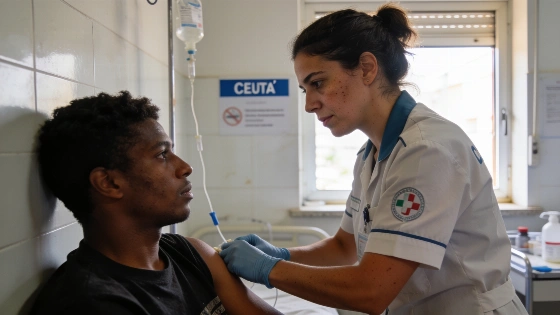
Ceuta’s only hospital has faced a sharp increase in demand after thousands of migrants crossed from Morocco at the end of July, but Spain’s Ministry of Health insists the system is holding. Minister Mónica García, after meeting with Ceuta’s president Juan Jesús Vivas, rejected claims of a “collapse” and stressed that while the situation is tense, essential services for residents continue without interruption.
García called for immediate action to provide safe, sanitary spaces for migrants, warning that the real risk lies outside hospital walls, where many remain in makeshift camps. She emphasized that associating migrants with disease is both unfair and xenophobic, and highlighted the need for public health measures to prevent further outbreaks. The minister reported that, over the past two weeks, 5,800 migrants have received medical attention in Ceuta—3,500 in primary care and 2,300 in hospital settings. The initial surge saw over 1,100 treated in a single day, but daily numbers have since dropped by 70%.
Despite the strain, García confirmed that no surgeries or consultations for local residents have been suspended, and the hospital remains at level 1 of the national emergency response guide. She credited the dedication of Ceuta’s 1,475 healthcare workers, supported by 60 additional staff brought in for the crisis, for preventing a breakdown in services. However, she noted that the Ministry has not needed to request reinforcements from other regions or cancel staff holidays, unlike the military and Guardia Civil.
President Vivas, meanwhile, maintains that Ceuta lacks the resources to house the new arrivals and has called for their immediate return. The local government has begun relocating unaccompanied minors from a sports hall to two industrial buildings, but these facilities can only accommodate a fraction of those in need. According to the city, nearly 1,900 minors have been registered by police so far.
Medical staff have reported a spike in cases of gastroenteritis, isolated incidents of tuberculosis and scabies, as well as heatstroke and injuries linked to poor living conditions. As of Sunday, 28 migrants remained hospitalized. García stressed that the presence of illness among migrants should not be used to justify xenophobic attitudes, noting that similar health issues exist among the local population.
Public frustration has grown, with some residents voicing anger during the minister’s visit. Healthcare workers have also raised concerns about workload and resources. The government of Ceuta has urged the Ministry to address the demands of medical staff, describing the current moment as one of the most critical in the city’s recent history.
In addition to health concerns, García confirmed that five migrant women have received care after sexual assaults. The situation in Ceuta has drawn national attention, echoing previous crises where local services were overwhelmed. For further context on the political and operational challenges faced by Ceuta during similar surges, see this analysis of government response and public backlash: how previous crises in Ceuta have intensified scrutiny of officials.
Ceuta’s experience highlights the ongoing challenges Spain faces at its borders, where sudden increases in arrivals can quickly strain local infrastructure. The city’s unique position as a Spanish enclave in North Africa makes it a frequent entry point for migrants seeking to reach Europe. The government’s response in Ceuta is closely watched as a test of Spain’s broader migration and public health policies. The need for coordinated action between local and national authorities remains urgent, especially as pressure on resources continues and public debate intensifies.