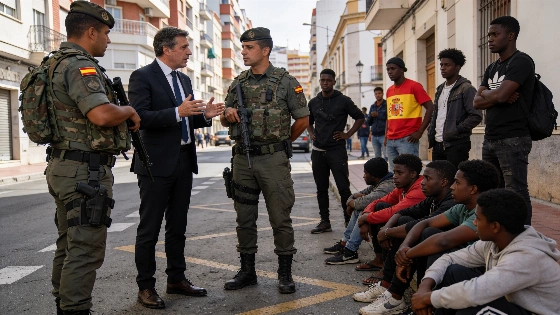
Ceuta’s leader calls for urgent action as the city struggles with thousands of recent arrivals. The government is pressed for a concrete plan to return migrants. Residents report worsening conditions.
Ceuta’s president, Juan Jesús Vivas, has intensified calls for urgent government action as the city continues to grapple with the aftermath of a mass entry of 72,000 people across its border. Speaking after a meeting with Defence Minister Margarita Robles, Vivas insisted that the situation is deteriorating daily and demanded an immediate plan for the return of migrants, echoing promises made by Foreign Minister José Manuel Albares.
Vivas described the current state in Ceuta as unsustainable, warning that each day without decisive measures further undermines the city’s stability. He stressed that the ongoing presence of hundreds of migrants—both adults and minors—on Ceuta’s streets, nearly two weeks after the border incident, is disrupting daily life and fueling a sense of abandonment among residents. According to Vivas, the events amounted to a direct attack on Spain’s territorial integrity, with the crisis deepening as time passes.
During his appearance at City Hall, Vivas highlighted the unique approach of Defence Minister Robles, who engaged directly with local residents affected by the crisis. He noted that, unlike other ministers, Robles showed a willingness to listen and understand the community’s concerns. Vivas also called for a greater military presence in Ceuta, arguing that defending the city is essential for Spain’s broader security. He reiterated his request for the confinement of those still living on the streets, a measure he had already proposed earlier in the week.
The president’s stance reflects ongoing mistrust toward Morocco, which he described as an unreliable partner. Vivas warned that the issue cannot be considered resolved even if migrant returns are eventually carried out. He urged the government to assess what Ceuta and Spain need to prevent similar incidents in the future, emphasizing that nothing vital to Ceuta’s functioning—whether economic activity, border management, or migration control—should depend on Morocco.
As the crisis continues, the city remains under pressure, with many residents expressing frustration over the lack of clear solutions. The demand for a structured return plan and reinforced security measures has become central to local debate. For additional context on the initial escalation and the government’s emergency response, see the detailed coverage at this earlier report on the Ceuta border crisis.
Ceuta, a Spanish enclave on the North African coast, has long faced challenges related to irregular migration due to its proximity to Morocco. The recent surge in arrivals has tested the city’s infrastructure and strained relations between local and national authorities. The Spanish government has previously reinforced border security and deployed additional police and military personnel in response to similar incidents. However, the scale of the current crisis has prompted renewed debate over Spain’s migration policies and the need for sustainable, long-term solutions that address both humanitarian and security concerns.