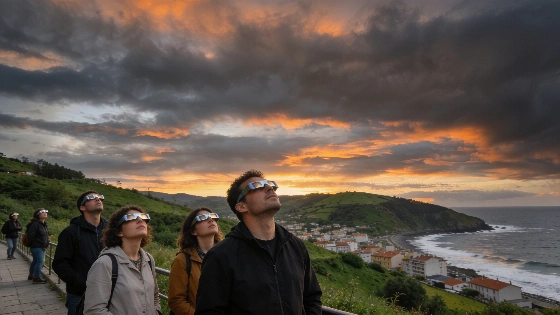
Spain faces cloud cover in key regions just before the solar eclipse. Meteorologists warn of high temperatures, isolated storms and extreme wildfire risk. Visibility may be limited in the north and Canary Islands.
With just two days left before the anticipated solar eclipse, Spain’s weather forecast remains largely unchanged, but new details highlight potential obstacles for skywatchers. The latest update from the Agencia Estatal de Meteorología (Aemet) points to a stable and intensely hot day on August 12, but with notable cloud cover expected in the Cantabrian region, the Pyrenees, the northern Canary Islands, and mountain areas in the east. These conditions could complicate eclipse viewing in several parts of the country.
According to Aemet spokesperson Rubén del Campo, most of Spain will see clear skies, but persistent clouds are likely along the Cantabrian coast, parts of Galicia’s shoreline, the northern Canary Islands, and the southern Mediterranean coast of Andalusia. In addition, evolving cloud formations are forecast for the northern and eastern mountain ranges, with a chance of isolated storms or showers in the eastern Pyrenees, Teruel’s Iberian system, eastern Castilla-La Mancha, and the eastern Béticos. No significant rainfall is expected elsewhere, and only Murcia faces a yellow-level storm warning, the lowest on the scale.
For those planning to observe the eclipse, the Cantabrian coast and the Canary Islands are set to be the most challenging locations due to persistent low clouds, especially along the coastlines. In contrast, the Pyrenees and eastern mountains will see clouds develop after midday, but these are expected to dissipate by late afternoon, potentially allowing intermittent views of the sun. A layer of Saharan dust (calima) is also forecast for the Alborán Sea, southernmost Andalusia, Lanzarote, and Fuerteventura, which may reduce visibility but is not expected to block the eclipse entirely.
Temperatures will climb across most of Spain, with Mediterranean cities like Palma and Málaga starting the day above 25°C. Afternoon highs will exceed 36°C in many areas, except for coastal zones, and could surpass 38–40°C in the northeast, central, and southern regions, as well as Mallorca. The Ebro, Tajo, Guadiana, and Guadalquivir valleys may see temperatures above 40°C. By the time the eclipse occurs, temperatures are expected to drop by 2–5°C from their peak, depending on the region. However, unlike longer morning eclipses, this event will have minimal impact on temperatures due to its brief duration—just over a minute—and its timing at sunset, when solar heating is already waning.
Authorities are particularly concerned about the extremely high wildfire risk across much of Spain, especially in inland Galicia, Castilla y León, northern Aragón and Catalonia, and isolated areas in the southern half of the country. Del Campo urges caution for anyone heading outdoors to watch the eclipse, warning that any fire outbreak could be difficult to control under these conditions.
As Spain prepares for the eclipse, local authorities and emergency services are on alert, echoing the extensive planning seen in Catalonia, where officials expect a surge of visitors and have implemented special security and mobility measures. The combination of high temperatures, cloud cover, and fire risk means that both residents and tourists should stay informed and take precautions during this rare astronomical event.
Solar eclipses are rare in Spain, and their visibility depends heavily on local weather. The Cantabrian and Canary regions often experience persistent cloud cover due to their geography, while Saharan dust events are common in the south and islands. The yellow-level storm warning in Murcia is the lowest alert, but authorities advise vigilance. The risk of wildfires is heightened by prolonged heat and dry conditions, making fire prevention a top priority during outdoor activities. The eclipse’s brief duration and late timing mean it will not cause the rapid temperature drops seen in longer, midday events. Residents are advised to monitor updates from Aemet and local authorities for the latest safety guidance.