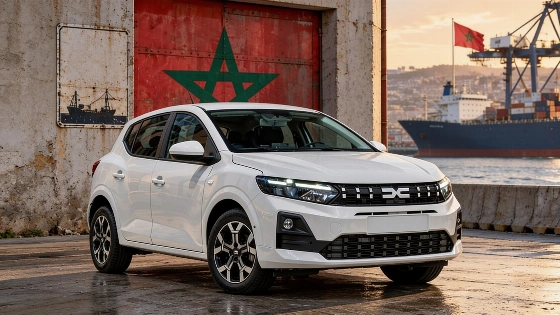
The Dacia Sandero leads Spanish car sales in 2026, but nearly every unit now rolls out of Morocco. With over 98 percent built in Tangier and Casablanca, Spain’s favorite car is a North African export.
If you buy Spain’s most popular car in 2026, chances are it was built far from Spanish soil. The Dacia Sandero, now at the top of Spain’s sales charts, is almost entirely made in Morocco. Its Romanian origins are now just a footnote.
Renault Group’s 2025 numbers show how much things have changed. Out of 276,817 Dacia Sanderos built worldwide, 271,795 came from Morocco. The Tangier plant alone turned out 222,257 cars. Casablanca’s SOMACA factory added 49,538 more. Meanwhile, the original Dacia plant in Mioveni, Romania, made just 5,022 units. That’s only 1.8 percent of the total.
The SOMACA plant in Casablanca has been producing Renault vehicles since 1966 and Dacia models since 2005, highlighting the long-term stability of Morocco's automotive industry.
This isn’t a statistical fluke. Dacia and Renault moved Sandero production to Morocco on purpose. They wanted to free up space in Romania for other models. The Moroccan plants, especially Tangier with more than 7,500 workers, now anchor Dacia’s European supply chain. Both Tangier and Casablanca serve the local market and act as export hubs. Most of their cars head to Europe.
The effect in Spain is clear. From January to August 2026, 23,769 Dacia Sanderos were registered in Spain. That puts it ahead of the SEAT Ibiza (19,837) and Toyota Corolla (17,119). In August alone, the Sandero led with 2,037 sales. Renault doesn’t break down which factory supplies Spain, but with Morocco making almost all Sanderos, the source is obvious. According to Spanish car statistics from ANFAC and other industry sources, the Sandero has been Spain’s best-selling car for over 13 years, with more than 400,000 sold since 2008.
Still, the 98.2 percent figure is for total production, not just Spanish sales. Without Renault’s internal shipping data or a full check of vehicle identification numbers, no one can say for sure that 98.2 percent of Sanderos sold in Spain are Moroccan-built. But the industrial facts are plain: Morocco is now the main Sandero producer, and its factories supply most of Europe. Renault Group and industry analysts say the move was made to get the most out of production lines and logistics for all Dacia models.
In 2026, Dacia introduced the Sandero Hybrid 155, with its hybrid powertrain developed and produced in Valladolid, Spain, marking a new phase of product innovation for the model.
Morocco’s rise as a car exporter goes beyond the Sandero. The country’s Ministry of Industry and Commerce points to models like the Sandero, Sandero Stepway, Logan, and Jogger, all carrying the “Made in Morocco” label. These cars are key for both local sales and European exports. Morocco has become a major player in Europe’s car market. Dacia is now investing in new models and tech for its Moroccan plants, which will only deepen this trend.
For Spanish buyers, it’s a strange twist. Local carmakers fight for market share, but the car most Spaniards pick is now almost entirely Moroccan. The Sandero’s low price and easy access keep it popular, but its success is tied to North African factories that now shape its identity.
As the car market changes, Spain’s dependence on imports—even for its top seller—raises questions about the future of local manufacturing and the shifting map of European industry. The Sandero’s shift from Romanian icon to Moroccan export shows how production decisions can change whole markets. For anyone watching the industry, Morocco’s rise as a manufacturing force matters as much as the sales numbers. This shift is similar to what’s happening with the recent expansion of Chinese automakers in Spain.
The real story isn’t just the Sandero’s sales lead. It’s how quickly and completely Morocco has become essential to Europe’s car supply. The numbers are clear: Spain’s favorite car is now, for all practical purposes, a Moroccan product. This forces a new look at what “European” means—and shows that the center of the continent’s car industry is moving south.