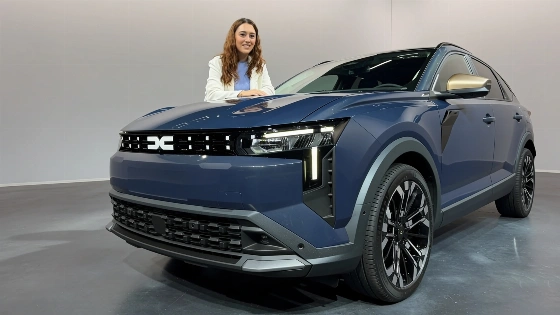
Dacia’s Striker enters the European C-segment with a striking crossover design, advanced hybrid engines, and a starting price below €25,000. Spacious, robust and tech-forward, it aims to set a new benchmark for value and practicality.
With the arrival of the Dacia Striker, the C-segment—already accounting for 40% of European car sales—faces a new contender that refuses to blend in. Dacia’s latest model is not just another SUV; it’s a crossover that merges the elevated driving position of an SUV, the practicality of a family car, and the efficiency of a sedan, all wrapped in a package that starts below €25,000, according to the brand.
Physically, the Striker stands out with its 4.62-meter length and 1.53-meter height, dimensions that lean closer to a sedan than a conventional SUV. Its 20-centimeter ground clearance, however, signals genuine versatility for mixed road conditions. The exterior design is defined by a pronounced shoulder line stretching from hood to tailgate, fluid upper contours, and robust lower volumes. Integrated roof bars and signature black bands on the grille and rear, paired with T-shaped LED headlights at each corner, reinforce its distinctive look.
Interior and Practicality
Inside, the Striker continues Dacia’s tradition of minimalist, driver-focused cabins, but with a clear step forward in technology and usability. Materials are comfortable rather than luxurious, but the layout is thoughtfully functional. The dashboard groups essential controls within easy reach, using physical buttons for intuitive operation without distraction.
Every Striker comes equipped with a 10.1-inch central touchscreen, supporting either the Media Display or Media Nav Live systems depending on trim. The latter adds connected navigation with real-time traffic and map updates for eight years, plus a six-speaker Arkamys 3D Sound System. A 7-inch LightVisio digital instrument panel, standard across the range, uses optical reflection to project key driving data as a floating image, enhancing clarity without clutter.
Space is a clear priority. The Striker comfortably seats five adults and boasts a class-leading 600-liter boot, making it one of the most practical options in its segment. Dacia introduces several clever features, including a hands-free tailgate that opens when the key is detected nearby, a modular three-piece boot floor, and rear seatbacks that fold flat from the cargo area. The YouClip system allows accessories to be attached at nine points throughout the cabin, while details like an integrated ice scraper and ample storage in the center console underline the focus on everyday convenience.
Hybrid Powertrains Only
Dacia has committed to an all-electrified engine lineup for the Striker, offering three distinct options. The entry-level mild hybrid-G 140 pairs a 1.2-liter three-cylinder petrol engine with a 48V mild hybrid system, capable of running on both petrol and LPG. The electric assist supports starts and acceleration, while regenerative braking charges the 0.8 kWh battery.
Above this sits the Hybrid 155, which combines a 1.8-liter naturally aspirated petrol engine (109 hp) with two electric motors, a 1.4 kWh battery, and a clutchless automatic gearbox. This setup allows the Striker to drive up to 80% of the time in full-electric mode in city traffic, always starting silently on electric power.
The highlight of the range is the Hybrid 150 4x4, introducing electrified all-wheel drive. The front axle uses the 1.2 mild hybrid petrol engine (140 hp) with a dual-clutch automatic, while the rear axle features a separate 31 hp electric motor. Five driving modes—Auto, Eco, Snow, Mud/Sand, and Off-Road—adapt the car to varying surfaces. In urban and suburban settings, up to 60% of driving can be electric. Hill Descent Control, standard on the Extreme trim, maintains a steady speed between 3 and 30 km/h on steep descents.
Efficiency and Market Impact
Efficiency was a core focus in the Striker’s development. With a drag coefficient of just 0.29 and a weight around 1,400 kg, Dacia expects the model to deliver low fuel consumption and one of the lowest total cost of ownership (TCO) figures in its class—a key consideration for both private buyers and fleet operators.
Orders for the Dacia Striker will open in October, coinciding with its debut at the Paris Motorshow. The model will be built at the Bursa plant in Turkey, targeting customers who want value without sacrificing technology or space.
The Striker’s launch comes as the C-segment heats up with new hybrid and electric offerings. For those interested in how other brands are pushing the boundaries of hybrid performance, the recent unveiling of the Aston Martin Valhalla—a €1 million supercar blending Formula 1 technology with hybrid innovation—offers a glimpse into the high end of this evolving market. Read more about this trend in our coverage of Aston Martin’s radical hybrid approach.
As Dacia positions the Striker as a practical, affordable, and technologically advanced alternative, its impact will likely be felt not just among budget-conscious buyers, but across a segment where expectations for value and innovation continue to rise.