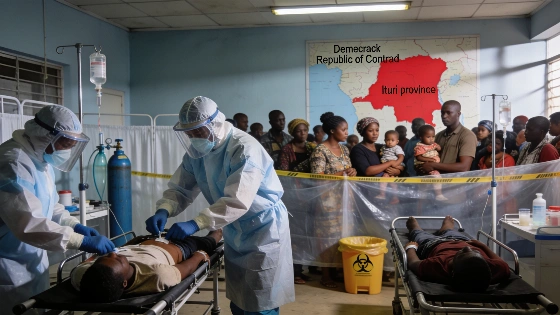
The Ebola outbreak in the Democratic Republic of Congo has surpassed 2,000 cases. Health authorities warn of rapid community spread. Intensive efforts are underway, but most new infections escape tracing.
The Ebola epidemic in the Democratic Republic of Congo has reached a critical stage, with the World Health Organization confirming 2,073 cases and 796 deaths. The outbreak, now the third largest ever recorded, is spreading at an unprecedented pace, particularly in the Ituri province. Health officials report that more than 80% of new infections are occurring outside known contact lists, highlighting a severe breakdown in community tracing and containment.
According to the latest update from the WHO's director general, Tedros Adhanom Ghebreyesus, the situation has deteriorated rapidly since the government declared the epidemic two months ago. The current outbreak has surpassed the speed of previous crises, with the number of confirmed cases exceeding 2,000 in just a fraction of the time it took during the 2018–2019 wave. This acceleration has raised alarm among international health agencies and local authorities alike.
Intense transmission in Ituri remains the central concern for response teams. The majority of deaths are occurring within communities, often among individuals who never reached medical facilities. This pattern complicates efforts to isolate cases and prevent further spread. Despite these challenges, the response has scaled up significantly: treatment capacity now exceeds 800 beds, diagnostic laboratories have expanded from one to sixteen, and contact tracing effectiveness is approaching 80%. Over 21,000 community workers are being trained to support the response on the ground.
Scientific progress offers some hope amid the crisis. Several clinical trials are underway, including tests of the monoclonal antibody MBP134, the antiviral remdesivir, and the new ChAdOx1 vaccine developed by the University of Oxford. Additionally, a post-exposure prophylaxis trial with obeldesivir has begun for those exposed to confirmed cases but not yet symptomatic. While no vaccine or treatment has full approval, 377 patients have recovered so far, underscoring the importance of early diagnosis and safe care.
There are signs of progress beyond Congo's borders. In neighboring Uganda, the last confirmed Ebola patient has been discharged, starting a 42-day countdown to officially declare the end of the outbreak there. Uganda's containment measures have limited the impact to 20 cases and two deaths, a stark contrast to the situation in DR Congo. The regional response has drawn attention to the importance of rapid intervention and cross-border cooperation, themes also explored in recent coverage of emergency management, such as the debate over wildfire response in Almería.
For Spain and other European countries, the developments in Central Africa serve as a reminder of the persistent threat posed by infectious diseases and the need for robust public health systems. While the current outbreak remains concentrated in DR Congo, the risk of cross-border transmission and the challenges of community-based containment highlight vulnerabilities that are relevant far beyond the region. The ongoing scientific trials and international cooperation may shape future strategies for epidemic response, both in Africa and globally.