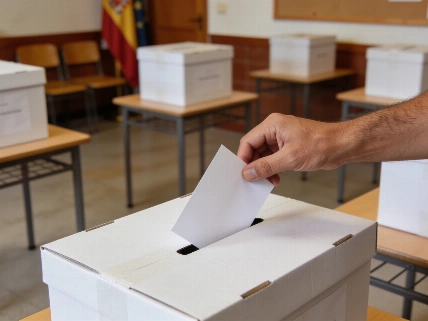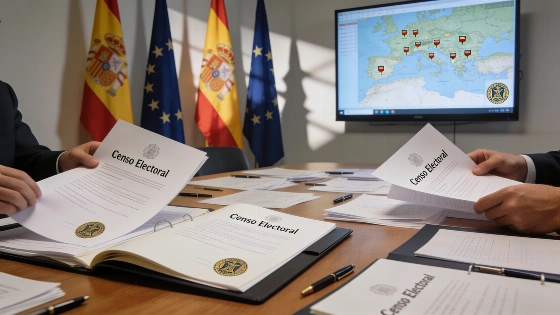
Spain’s Electoral Board has refused Vox’s call to suspend the overseas voter census. Instead, it demands the INE clarify how municipalities are assigned to new citizens. The move follows rising political tension over the 'law of grandchildren.'
The Central Electoral Board (Junta Electoral Central, JEC) has dismissed Vox’s request to suspend the overseas voter census, but has ordered the National Statistics Institute (INE) to clarify how municipalities are assigned to newly nationalized citizens under the so-called 'law of grandchildren.' The decision, announced Thursday, comes amid mounting political friction over the application of the 2022 Democratic Memory Law, which enabled thousands of descendants of Spanish exiles to obtain citizenship.
Vox and several organizations had challenged the current system, arguing that a provision in the law could be interpreted ambiguously and might allow for questionable increases in the number of overseas voters. The JEC, however, emphasized that the overseas census (CERA) has been in place since 2011 without prior complaints, and found no grounds to halt its use now.
The Partido Popular (PP), led by Alberto Núñez Feijóo, also raised concerns about a surge in citizenship applications, suggesting it could be a form of 'electoral engineering' by the government. Although the PP later shifted its stance to demand greater transparency, a PP-nominated member of the JEC has formally dissented from the Board’s majority decision, underscoring the ongoing political divide.
In its response to Vox, the JEC cited the Spanish Constitution, which guarantees the right to vote for all Spaniards, including those living abroad. The Board also clarified that it does not have authority over the granting of nationality or the interpretation of laws, advising critics to take their concerns to the Constitutional Court or administrative courts if they wish to challenge the legislation.
The JEC’s main concern now centers on how the INE and its Office of the Electoral Census determine the municipality in which new citizens are registered to vote. The Board noted that while the INE’s July 10 report confirmed mechanisms for updating and tracking the overseas census, it did not provide a definitive legal assessment of the procedures used to assign municipalities to new voters.
According to the JEC, the choice of municipality is crucial, as it determines the electoral district for each voter. The Board insists that the criteria for this assignment must be objective, consistent, and transparent, and that all consular offices should apply them uniformly to ensure fairness and clarity in the electoral process.
To address these issues, the JEC has asked the INE to specify whether it reviews explanations from voters who request registration in a municipality other than their last Spanish residence, and who is responsible for such reviews. The Board also wants to know if consular offices document the criteria they use when assigning municipalities in the absence of clear guidelines, and whether these criteria are subject to oversight by the INE.
The JEC further recommends that the INE issue a formal instruction to consular offices, detailing the standards for determining a voter’s municipality. This should include how to prove ties to a particular area, what supporting documents are required, and when officials should assign a municipality by default. The Board stresses that every decision must be properly justified in the voter’s file, especially when the municipality is not based on the last Spanish address, to guarantee transparency and equal treatment.
Spain’s overseas voter census, known as CERA, has long been a point of contention in political debates, particularly during periods of electoral reform or heightened migration. The current dispute echoes previous controversies over the integrity of voting processes and the balance between expanding suffrage and maintaining electoral safeguards. For context, recent political disputes in Spain have also focused on emergency responses and transparency, as seen when Andalusian opposition parties demanded answers from regional leaders after the Los Gallardos wildfire.
The JEC’s latest move signals a push for greater clarity and uniformity in how overseas voters are integrated into Spain’s electoral system. As the country continues to grapple with questions of citizenship, migration, and democratic participation, the outcome of this review could shape future elections and the rights of Spaniards living abroad.