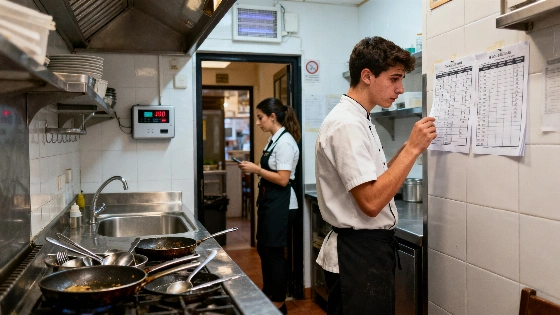
Supreme Court of Spain bans merging daily and weekly rest days in hospitality schedules. The Supreme Court of Spain has put an end to the dispute over work schedules in the hospitality sector. Now, employers are required to provide employees with separate, uninterrupted daily and weekly rest periods—no loopholes allowed. Violations may result in serious fines.
If a waiter finishes their shift at midnight and their next workday starts the following morning, the scheme familiar to many will no longer be allowed. The Supreme Court of Spain has ruled illegal the practice of including the minimum daily rest period within a day off, depriving employees of full recovery time. Now, employers are required to clearly separate both types of rest — between shifts and weekly.
This concerns a common situation in bars and restaurants: an employee closes the establishment late in the evening, and the next day has a day off, which in reality is partially spent recovering from the night shift. The court decision of March 12, 2026 (Sentencia 274/2026) explicitly prohibits such overlaps, emphasizing that daily and weekly rest are two separate rights and cannot be combined for business convenience.
For employees, this means they can no longer be required to start a shift until 12 hours have passed since the previous one ended, even if a day off is ahead. The minimum weekly rest — one and a half consecutive days, and in many collective agreements two days — must be provided in addition to the daily break. For example, if a shift ends at 00:00 on Sunday, the 12-hour daily rest lasts until noon on Monday, and only after that does the weekly day off begin.
The introduction of digital working time tracking from 2026 makes compliance monitoring a reality. The labor inspectorate requires all working hours to be recorded in secure electronic systems with remote access. Any violation—such as an employee starting a shift earlier than scheduled, or when rest periods between shifts and on days off overlap—can lead to a fine of up to €10,000 per employee.
For catering establishments, this means they will need to revise schedules, especially during peak periods. Even if temporary flexibility is allowed during the season, overtime compensation and full weekly rest must be ensured. The Sixth Sectoral Agreement for the hotel and restaurant sector strengthens worker protections, especially in disputes over schedules and sanctions.
The practical significance of the decision lies in the genuine protection of the right to rest. Employers will no longer be able to "save money" on staff rest through formal manipulation of schedules. As Talent24h notes, this decision is particularly important for those working with unstable shifts and seasonal overloads.
Issues concerning labor rights and compensation in Spain are becoming increasingly relevant. For example, there was recent discussion about allowing self-employed individuals to replace disability pensions with a lump-sum payment—learn more about this in the article about new rules for the self-employed.
The Supreme Court's decision is already affecting practice: labor inspectors are increasingly scrutinizing work schedules, and employees have gained an additional argument in disputes with employers. For the industry, this is a signal: formal loopholes no longer work, and the right to rest is becoming a real standard.