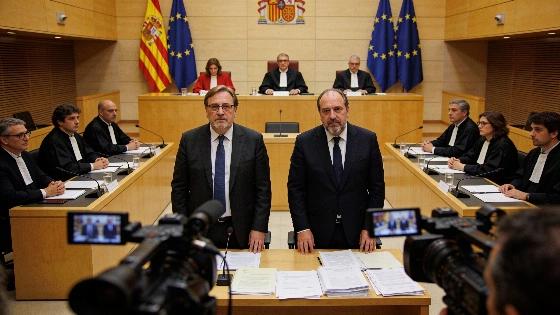
The EU Court's support for Spain's amnesty law has sparked immediate calls for action. Catalan politicians urge Spanish courts to apply the ruling without delay. The decision could impact high-profile exiles and reshape political dynamics.
The European Court of Justice's endorsement of Spain's amnesty law has triggered a wave of demands from Catalan independence leaders for immediate implementation. The ruling, which directly affects figures such as Jordi Turull and Oriol Junqueras, has intensified scrutiny on the Spanish Constitutional Court (TC) and its handling of cases involving former Catalan officials. Turull, a senior member of Junts per Catalunya and one of those convicted for misuse of public funds, insisted that the TC cannot postpone decisions while fundamental rights remain at stake. He argued that the court now has both the authority and the obligation to act without further delay.
The timing of the TC's response has become a focal point. The court had planned to address appeals related to the Supreme Court's refusal to apply the amnesty to former Catalan government members later in the year. However, following the EU court's clear stance, Turull and Junts' legal advisor Gonzalo Boye stressed that no further legal obstacles remain. Boye emphasized that the clarity of the European decision leaves no room for new preliminary questions or further debate, suggesting that the Spanish judiciary must now proceed with the law's application.
Despite the significance of the ruling, Turull avoided commenting on whether this new legal landscape could lead to closer cooperation with Prime Minister Pedro Sánchez's government or facilitate the return of Carles Puigdemont and other exiled leaders. He also cautioned the Socialist Party against claiming credit for the EU court's decision, attributing the legal breakthrough to Junts' persistent demands during negotiations with PSOE and Esquerra Republicana earlier in 2024.
Puigdemont, who remains in Belgium under a Spanish arrest warrant, followed the court proceedings remotely alongside Junts' leadership in Barcelona. In response to Catalan president Salvador Illa's statement that the amnesty marks an end to division and conflict, Turull countered that the measure serves as a rallying point for the independence movement rather than a conclusion to the political dispute. He argued that the ruling highlights the Spanish state's reliance on repression to address political challenges.
Esquerra Republicana echoed the call for swift action. Oriol Junqueras, speaking alongside key party figures who stand to benefit from the ruling, insisted that there are now no valid reasons for Spanish courts to delay. He called for the restoration of political rights and the return of exiled leaders, criticizing segments of the judiciary for allegedly serving partisan interests. The ruling could alter the legal status of Junqueras, Dolors Bassa, Raül Romeva, and others still facing disqualification sentences for misuse of public funds.
Junqueras expressed hope for the imminent return of Puigdemont and other exiles, underscoring the personal and political stakes involved. The developments come amid ongoing debates over the role of the judiciary in Spain's political conflicts, a theme that has surfaced in other high-profile cases, such as the controversy surrounding leaked private messages of former Prime Minister Zapatero, as reported in recent coverage of judicial and political tensions.
The EU court's decision is expected to accelerate legal proceedings for those affected by the amnesty law. While the immediate impact centers on Catalan leaders and exiles, the ruling may also influence broader debates about judicial independence and the handling of political disputes in Spain. The coming months will reveal whether Spanish courts respond to mounting pressure or maintain their current pace, with significant implications for the country's political landscape and the future of the independence movement.