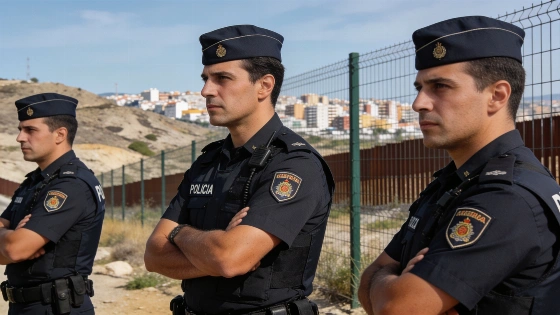
A leaked police report points to Morocco's involvement in the Ceuta border breach. Feijóo accuses the government of hiding warnings and calls for a tougher stance. The crisis exposes deep rifts over Spain's border security and foreign policy.
Spain’s political scene was shaken today when Alberto Núñez Feijóo, leader of the Partido Popular, accused the government of hiding advance warnings about the mass entry into Ceuta. Citing a confidential police report, Feijóo blamed Morocco for organizing the July 30 border breach and called for immediate diplomatic action.
Speaking in Ceuta with local president Juan Jesús Vivas, Feijóo said the government received repeated alerts from security services on July 27, 28, and 29 but ignored them. He argued that the operation, which saw about 70,000 people try to cross into the city, was not a spontaneous migration but a coordinated move allowed by Moroccan authorities. According to official estimates reported by Spanish media, around 72,000 people crossed the border during July 30–31, with several thousand still in Ceuta as of early August.
The Spanish government has announced plans to extend breakwaters at Tarajal and Bensu and deploy permanent maritime and aerial surveillance, including drones, to reinforce the Ceuta border.
The controversy grew after a National Police report, cited by El Español, appeared in court proceedings. The document reportedly describes Moroccan agents directing the mass crossing, contradicting the government’s claim of having no prior knowledge. Feijóo used this evidence to accuse the government of lying to the public and failing in its duty, while expressing support for the police and intelligence services. The Interior Ministry has rejected Feijóo’s version, saying intelligence services did not issue advance warnings about the scale of the crisis. Minister Grande-Marlaska has repeated this position in recent press statements.
Feijóo’s demands are clear: summon the Moroccan ambassador in Madrid to explain the incident and call the Spanish ambassador in Rabat back for consultations. He did not specify further steps, saying the party would respond based on Morocco’s explanations. This is a shift from earlier PP positions, which criticized Morocco’s awareness of the events but stopped short of direct accusations. Now, Feijóo is openly accusing Morocco of having "coordinated and permitted" the mass crossing, as reported by several national outlets.
The government faces growing pressure as the opposition uses the police report to stoke public anger. Feijóo accused Prime Minister Pedro Sánchez and Interior Minister Fernando Grande-Marlaska of putting political interests ahead of national security, referencing a letter from Marlaska to the police director asking when the force first received intelligence about Moroccan involvement.
The crisis has already triggered judicial and parliamentary scrutiny: Feijóo has called for an emergency session of the parliamentary secrets committee, and the Partido Popular plans to participate in the ongoing National Court case regarding the Ceuta events.
Calls for a tougher stance with Morocco have grown, with Vox urging suspension of the bilateral Treaty of Friendship and withdrawal of Spain’s ambassador. Until now, the PP had resisted such measures, but Feijóo’s latest statements point to a more confrontational approach. The timing is notable: the revelations come just before nationwide rallies for Ceuta Day, with Feijóo predicting large protests and arguing the government cannot protect Spain’s borders.
At the center of the dispute is the credibility of Spain’s security services and the government’s willingness to address its relationship with Morocco. The PP’s strategy is to highlight the government’s discomfort, amplify the sense of crisis, and present itself as the defender of national sovereignty. Still, the lack of detail about the proposed diplomatic response leaves open how far the opposition is willing to go beyond criticism.
Spain’s border with Morocco has long been a source of tension over migration and diplomacy. Ceuta and Melilla, as Spanish enclaves in North Africa, often face mass crossings that strain relations. The current standoff shows the fragility of Spain’s border management and the risks of unclear decision-making at the top. As the PP raises the stakes, the government’s next steps will determine whether this crisis changes Spain’s approach to border security and its relationship with Morocco.